Free lesson · Edexcel Economics A · 3.5.3, 3.4.6
Wage intervention and employer power
A legal minimum wage aims to raise pay at the bottom of the labour market. In a competitive model, a binding floor above equilibrium increases labour supplied and reduces labour demanded, creating excess supply of labour. The size of any employment reduction depends on demand elasticity and the level of the wage relative to equilibrium.
A maximum wage is a legal ceiling. If binding below a competitive equilibrium, it can create excess demand for labour: employers want more workers than are willing to supply at that wage. Public-sector wage setting is also influenced by budgets, recruitment needs, bargaining and service objectives, so it cannot always be described by a simple competitive market.
Worked example: at £10 per hour, firms demand and workers supply 1,000 hours. A £12 floor might reduce demand to 900 hours and raise supply to 1,100, leaving 200 hours of excess supply. This is a hypothetical competitive response, not an empirical forecast. A less elastic demand curve would produce a smaller employment reduction.
A binding minimum wage in a competitive market
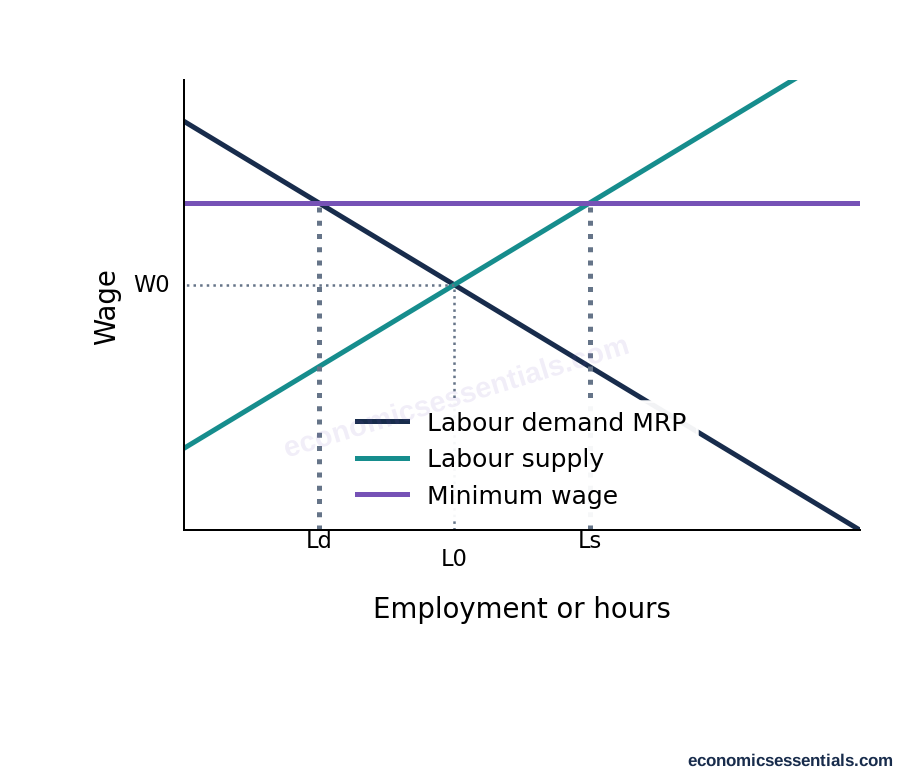
At the wage floor, labour supplied exceeds labour demanded. Compare this competitive-market prediction with the employer-power model below.
Employer power changes the prediction. A monopsonist faces an upward-sloping labour supply curve and must usually raise the wage to attract more workers. If that increase applies to existing workers too, marginal labour cost exceeds the wage. It chooses employment where MCL = MRP and reads the wage from supply, producing lower employment and pay than the competitive benchmark.
A suitably placed minimum wage can flatten the employer’s marginal cost over a range, raising both wages and employment towards the competitive level. Set too high, it can still reduce employment. Therefore, saying that minimum wages always destroy jobs or always increase employment ignores the market structure and the policy’s scale.
Monopsony and a carefully set minimum wage
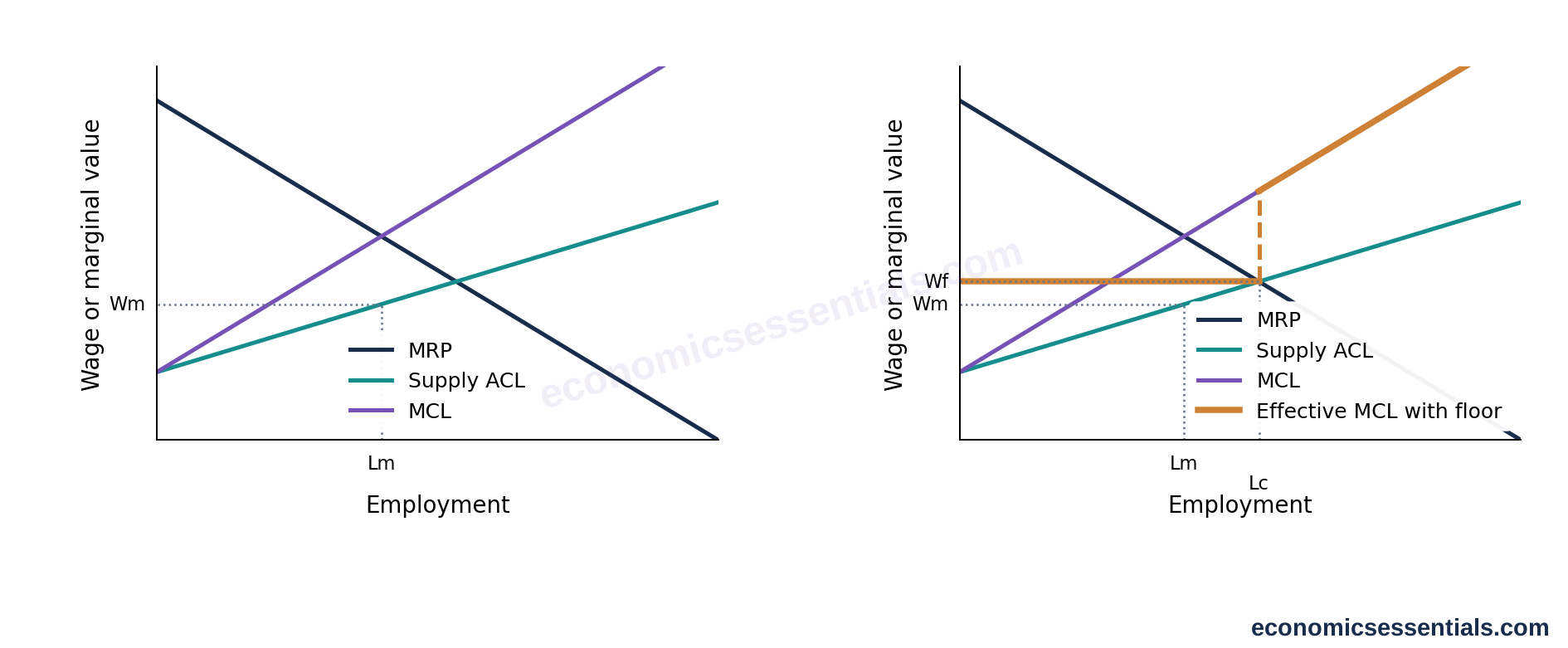
Without a wage floor the employer chooses Lm where MCL equals MRP, then pays Wm from labour supply. A floor at the competitive wage makes the effective marginal cost flat up to Lc, allowing higher wages and employment. A much higher floor can reduce employment.
Trade unions and collective bargaining can counter employer power, improve conditions and reduce information problems. However, wage bargains above a competitive level can reduce labour demand under the standard model. Stronger pay can also encourage effort, retention and training, so static cost comparisons may miss productivity responses.
Policies addressing immobility include retraining, apprenticeships, affordable housing, transport and accessible childcare. Public-sector recruitment problems may require pay changes alongside better workloads and career paths. A wage ceiling that restrains expenditure may increase vacancies or reduce service quality if workers leave.
Evaluation should use evidence on concentration, vacancies, turnover, productivity and actual employment changes. A before-and-after comparison alone cannot isolate a wage policy if demand changed simultaneously. Assess outcomes for workers who keep jobs, those seeking work, employers, consumers and taxpayers. A sound conclusion identifies the market conditions under which intervention improves pay and welfare, and distinguishes a theoretical possibility from an observed causal effect.
Key terms
- Minimum wage
- A legal floor on the wage paid for covered employment.
- Monopsony power
- A buyer’s ability to influence the price paid to suppliers, including workers.
- Collective bargaining
- Negotiation of employment terms between worker representatives and employers.
- Public-sector wage setting
- Determination of pay for workers employed by public bodies.
- Wage differential
- A difference in pay between workers or occupations.