Free lesson · Edexcel Economics A · 3.5.1, 3.5.2, 3.5.3
Labour demand, supply and wage differences
Demand for labour is derived demand: firms employ people because their work helps produce goods and services customers want. Stronger demand for the final product can therefore increase labour demand. Productivity, technology, other input prices and the wage also influence hiring decisions.
A useful marginal concept is marginal revenue product, or MRP: the extra revenue generated by an additional worker. It equals marginal physical product multiplied by the marginal revenue from the extra output. A profit-seeking firm compares MRP with the marginal cost of employing labour. Higher productivity or stronger output demand can shift labour demand right.
Labour supply to an occupation depends on wages, qualifications, training time, working conditions, status, migration and alternative jobs. A higher wage usually attracts more workers or hours into that occupation, other things equal. Long training requirements make supply less elastic in the short run. Market supply should not be confused with the work–leisure choices of a particular individual.
Worked example: an additional worker produces eight extra units each hour, and marginal revenue is £3 per unit. MRP is £24 per hour. If the full additional employment cost is £20, hiring can raise profit by £4 per hour at that margin. Employer pension contributions, recruitment and training costs mean the relevant cost may exceed the cash wage.
In a competitive labour market, equilibrium wages and employment occur where market demand equals supply. Higher demand tends to raise both; an increase in supply tends to reduce wages and increase employment, other things equal. Wage differences can reflect skills, productivity, scarce qualifications, working conditions and bargaining institutions. They can also reflect discrimination or unequal access to opportunities.
Competitive labour market equilibrium
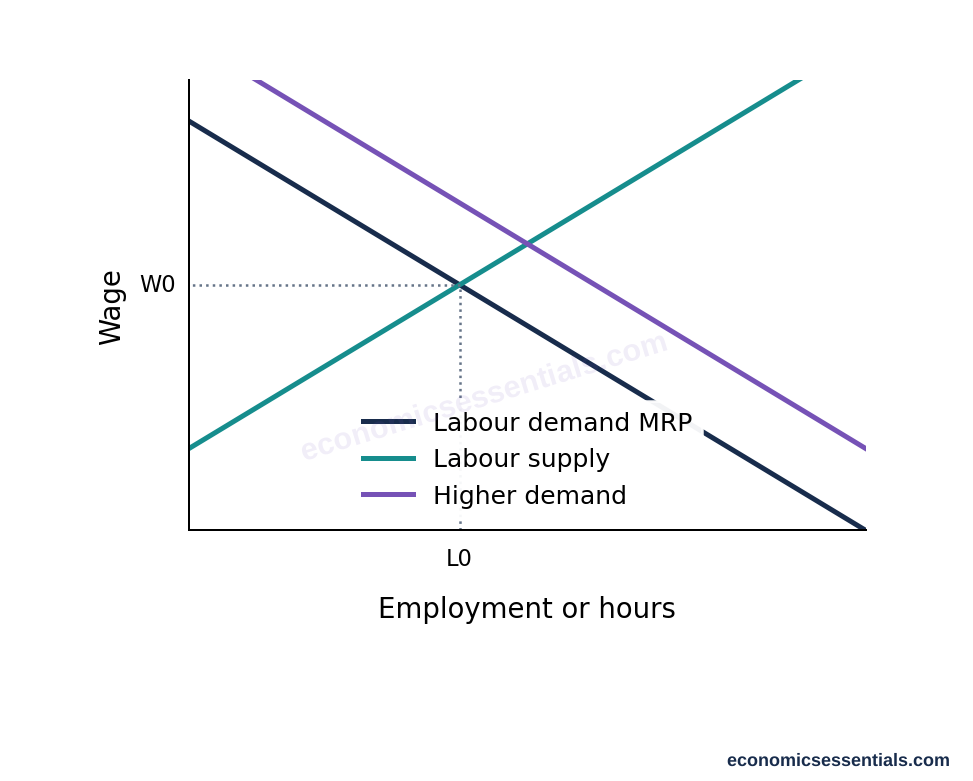
An increase in derived demand raises equilibrium wages and employment with labour supply unchanged. The relative size of each change depends on the elasticities.
Geographical immobility prevents workers moving to available jobs because of housing costs, family commitments or poor transport. Occupational immobility arises when skills do not match vacancies. These failures can leave unemployment alongside labour shortages. Retraining, recognition of qualifications, transport improvements and relocation support can improve matching, but take resources and time.
Labour-demand elasticity depends on substitutability with capital, labour’s share of costs, product-demand elasticity and the time available to adjust. Labour-supply elasticity depends on alternative workers, migration, training and participation. If supply is inelastic, a demand increase produces a larger wage rise and smaller employment increase.
Evaluation must consider both sides of the market. Automation can substitute for some tasks while complementing others. Migration expands supply but also demand and productive capacity. A pay rise may reduce turnover and improve productivity, offsetting some cost. Use the diagram as a starting mechanism, then consider skills, institutions and the scope for adjustment before predicting the final effect on wages or jobs.
Key terms
- Derived demand
- Demand for an input arising from demand for the output it helps produce.
- Marginal revenue product
- The additional revenue generated by one more unit of an input.
- Labour supply
- The amount of labour workers are willing and able to offer at different wages.
- Occupational immobility
- Difficulty moving between jobs because skills or qualifications do not match.
- Geographical immobility
- Difficulty moving between locations to take available work.