Free lesson · Edexcel Economics A · 3.6.1, 3.6.2
Competition policy, regulation and ownership
Competition policy aims to prevent market power from harming consumers, workers or suppliers while preserving genuine efficiency gains. A merger can reduce duplication and unit costs, but can also remove an important rival. Authorities therefore examine the relevant market, entry conditions, buyer power and likely effects on prices, quality, choice and innovation.
In the UK, the Competition and Markets Authority (CMA) investigates mergers and competition problems. Its work provides context for judging whether merger efficiencies outweigh reduced rivalry; a large firm is not automatically unlawful.
Intervention can block a merger, require asset sales or impose behavioural conditions. Monopoly regulation can include price limits, profit controls, quality standards and performance targets. Price-cap regulation gives firms an incentive to reduce costs because they can retain some savings between reviews. Profit regulation limits returns but may weaken incentives to economise or encourage overinvestment in the regulated asset base.
Natural monopoly and price regulation
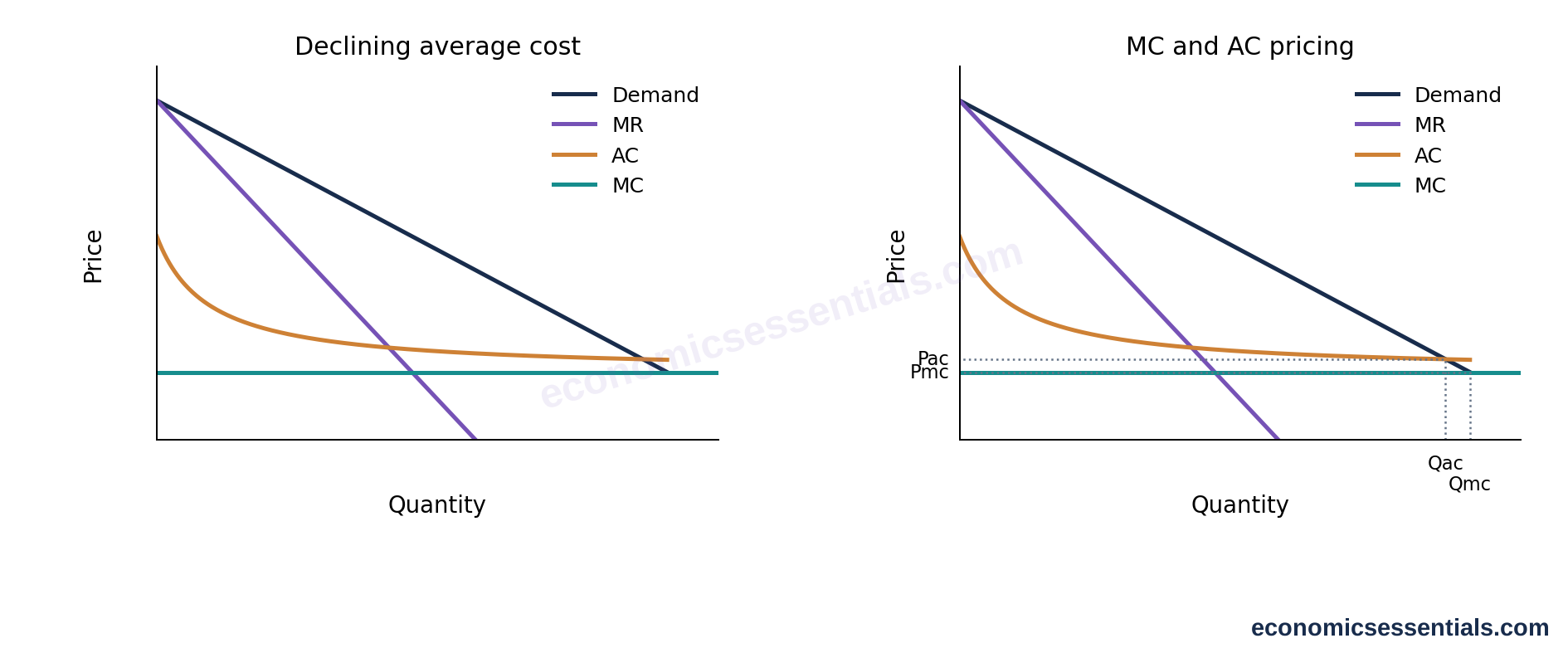
Falling AC over the market range makes duplication costly. Marginal-cost pricing reaches the efficient quantity but can leave AC above price and require subsidy. Average-cost pricing permits normal profit while leaving P above MC.
Worked example: a regulator allows a price increase equal to inflation minus an efficiency factor. With inflation of 4% and an efficiency requirement of 2%, the permitted nominal rise is approximately 2%. A £100 charge becomes £102 under the simple percentage rule. The exact formula and review design matter; this illustration is not a description of every actual regulatory regime.
A low price alone is not success if quality or investment collapses. Quality standards and service targets can prevent firms meeting a cap by cutting maintenance or access. Regulators face asymmetric information because firms know more about their own costs and investment needs. Regulatory capture occurs when supervision becomes overly aligned with the interests of the regulated industry.
Governments can promote competition through support for small businesses, deregulation and easier access to finance or infrastructure. Competitive tendering invites firms to bid for public contracts, creating competition for a market even where simultaneous operators would be inefficient. However, poorly written contracts can reward an unrealistically cheap bid followed by lower quality or renegotiation.
Privatisation transfers ownership to the private sector. It may strengthen commercial incentives, but does not automatically create competition if an existing monopoly is simply sold. Nationalisation can give government more direct control over prices, investment and service obligations, but may introduce political interference and weak cost discipline. Restrictions on buyer power can protect suppliers and employees from unfair terms or exclusionary conduct.
Evaluation compares governance and incentives rather than ownership labels alone. Can the regulator verify costs? Are quality outcomes measurable? Can customers switch? Will entry be credible? What happens if the provider fails? The appropriate structure may differ between a competitive retail activity and an expensive network with natural-monopoly features.
A reasoned judgement weighs lower prices against profit, efficiency, quality and choice over time. Preserve merger efficiencies only where they are credible and likely to benefit users. Combine competition with proportionate regulation where necessary, and recognise that intervention has information and enforcement costs of its own.
Key terms
- Competition policy
- Public measures intended to protect or promote effective competition.
- Price cap
- A regulatory limit on a firm’s price or permitted price increase.
- Privatisation
- Transfer of an activity or assets from public to private ownership.
- Nationalisation
- Transfer of an activity or assets into state ownership.
- Regulatory capture
- Regulation becoming overly aligned with the interests of the regulated industry.