Free lesson · Edexcel Economics A · 1.2.8, 1.2.9
Surplus, indirect taxes and subsidies
A customer willing to pay £8 for a meal but charged £5 gains £3 of consumer surplus. Across a market, consumer surplus is the area below demand and above price. Producer surplus is the area above supply and below price: revenue beyond the minimum needed to supply those units. It is not identical to profit because fixed costs may still need paying.
For straight curves, triangular surplus areas equal one half multiplied by base and height. Suppose equilibrium quantity is 60, price is £4, demand meets the price axis at £10 and supply at £1. Consumer surplus is ½ × 60 × 6 = £180. Producer surplus is ½ × 60 × 3 = £90. A supply increase typically reduces price and increases consumer surplus; changes in producer surplus depend on the combined price and quantity effects.
Consumer and producer surplus
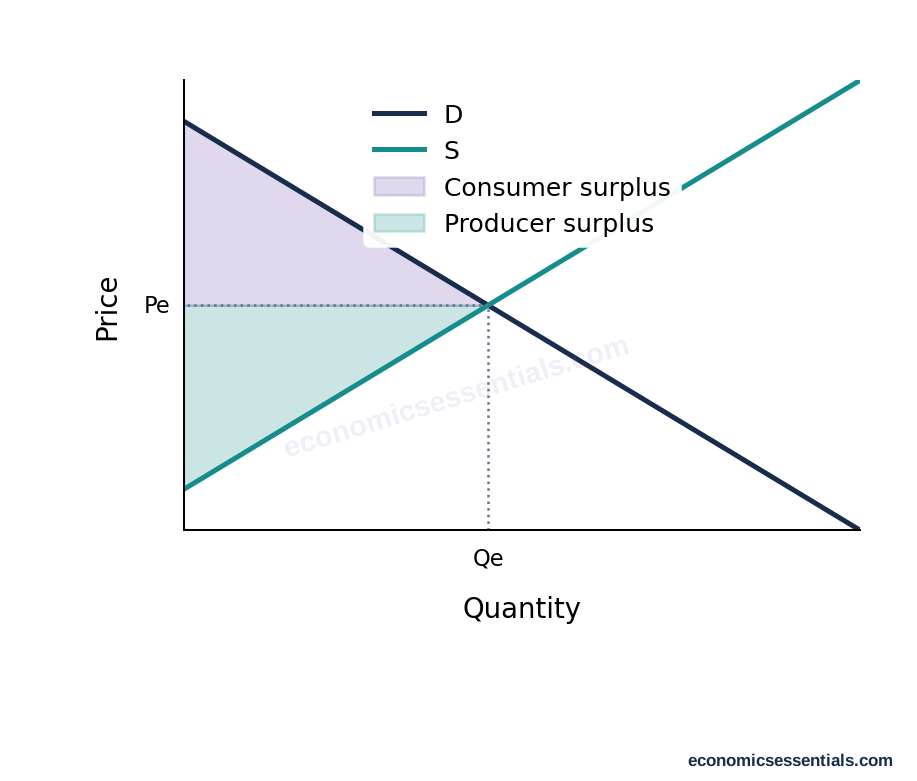
Consumer surplus lies below demand and above the equilibrium price. Producer surplus lies above supply and below the price. The areas measure gains from trade under the model assumptions.
An indirect tax is charged on spending or production. A specific tax is a fixed amount per unit and shifts supply vertically upwards by that amount. An ad valorem tax is a percentage of value, producing a widening tax wedge as price rises. Consumers pay a higher gross price, producers receive a lower net price, and the quantity traded usually falls.
Worked example: before tax, price is £4 and quantity is 60. After a £2 unit tax, consumers pay £5, firms receive £3 and 50 units are sold. Consumer incidence is £1 per unit and producer incidence is £1. Government revenue is £2 × 50 = £100. The standard deadweight-loss triangle is ½ × 2 × 10 = £10, assuming no externality and straight curves over the relevant range.
Tax incidence depends on relative elasticities, not on who physically sends money to the government. The less responsive side bears more of the burden. If demand is very inelastic, consumers cannot easily reduce purchases and tend to bear more. Government revenue is a transfer, not automatically a net welfare loss; the welfare triangle represents beneficial trades that no longer occur.
Specific and ad valorem taxes
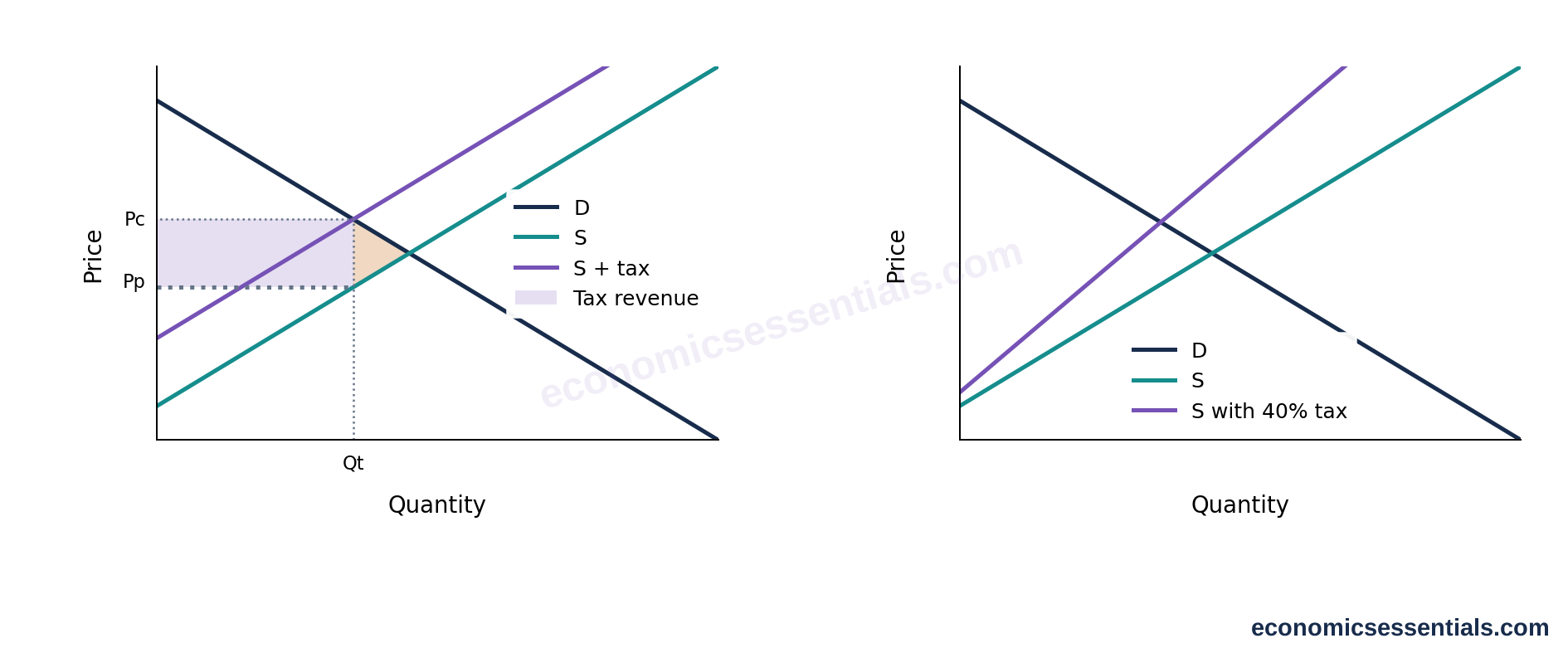
The specific tax is a constant vertical wedge. At Qt, Pc minus Pp equals the tax and the shaded rectangle is government revenue. The ad valorem wedge widens with the producer price; it is not a parallel shift.
A subsidy creates the opposite wedge: producers receive more than consumers pay. Supply shifts down, consumer price tends to fall and quantity rises. Government expenditure equals the subsidy per unit multiplied by the subsidised quantity. Some benefit may remain with producers rather than being fully passed to customers.
Subsidy and its incidence
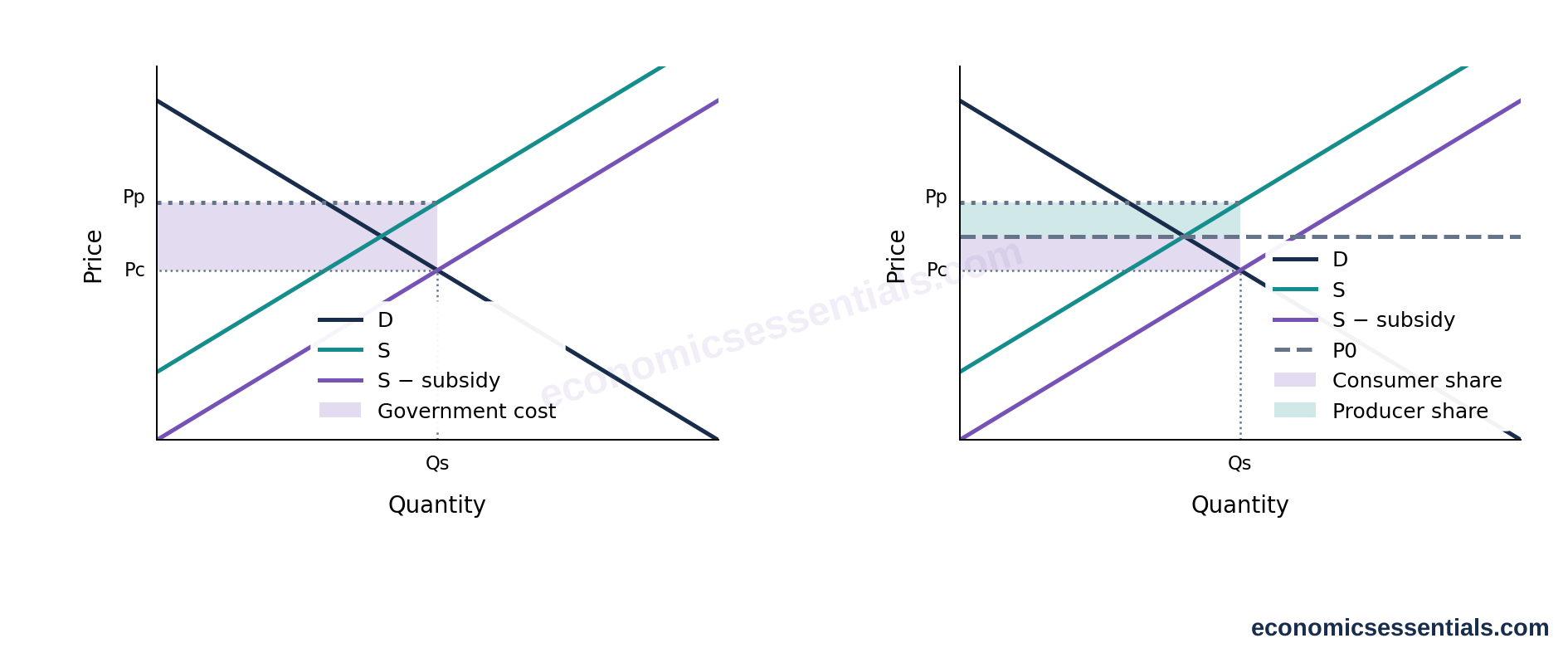
At the subsidised quantity, producers receive Pp while consumers pay Pc. The total government cost is the full wedge times Qs. The right panel splits that cost into the price benefit to consumers and producers relative to P0. Wider welfare effects depend on externalities.
Evaluation asks why intervention occurs. A pollution tax may improve welfare despite reducing private surplus, while a subsidy for external benefits can correct underconsumption. Without market failure, subsidies can encourage excessive output. Administrative costs, distributional effects and the opportunity cost of public funds must enter the final judgement.
Key terms
- Consumer surplus
- The difference between willingness to pay and the price actually paid.
- Producer surplus
- The difference between the price received and the minimum price producers would accept.
- Indirect tax
- A tax on expenditure on goods or services.
- Subsidy
- A government payment that reduces producers’ costs or supports consumption.
- Tax incidence
- How the economic burden of a tax is shared between buyers and sellers.