Free lesson · Edexcel Economics A · 1.3.1, 1.3.2
Market failure and external costs
A factory’s customers pay for its output, but nearby residents may pay through polluted air. Market failure occurs when the market allocates resources inefficiently, so social welfare could be improved. A market price can balance private demand and supply while overlooking important effects on people outside the transaction.
Private costs fall on the decision-maker; external costs fall on third parties. Social cost equals private cost plus external cost. Private benefits accrue to the buyer or seller; social benefits also include external benefits. At the margin, MSC = MPC + MEC and MSB = MPB + MEB. The socially efficient quantity is where marginal social benefit equals marginal social cost.
For a negative production externality, such as industrial emissions, MSC lies above MPC. With no consumption externality, demand represents both MPB and MSB. The market chooses Qm where MPB = MPC, exceeding the socially efficient Qs where MSB = MSC. Units between Qs and Qm cost society more than they benefit it, creating a welfare-loss triangle between MSC and MSB.
Worked example: demand is P = 100 − Q and private marginal cost is P = 20 + Q. Private equilibrium is Q = 40 and P = 60. If marginal external cost is £20 per unit, MSC = 40 + Q. Social efficiency requires 100 − Q = 40 + Q, giving Qs = 30. Welfare loss is ½ × 10 × £20 = £100. A £20 corrective unit tax would align the private and social marginal costs in this simplified model.
A negative consumption externality is drawn differently. If consumption harms others, MSB lies below MPB, while MPC and MSC coincide when production has no externality. The market again overconsumes, but the welfare gap is between private and social benefit. Passive smoking is an example of harm to third parties; the smoker’s own health damage is a private cost, potentially compounded by information failure.
Negative externalities
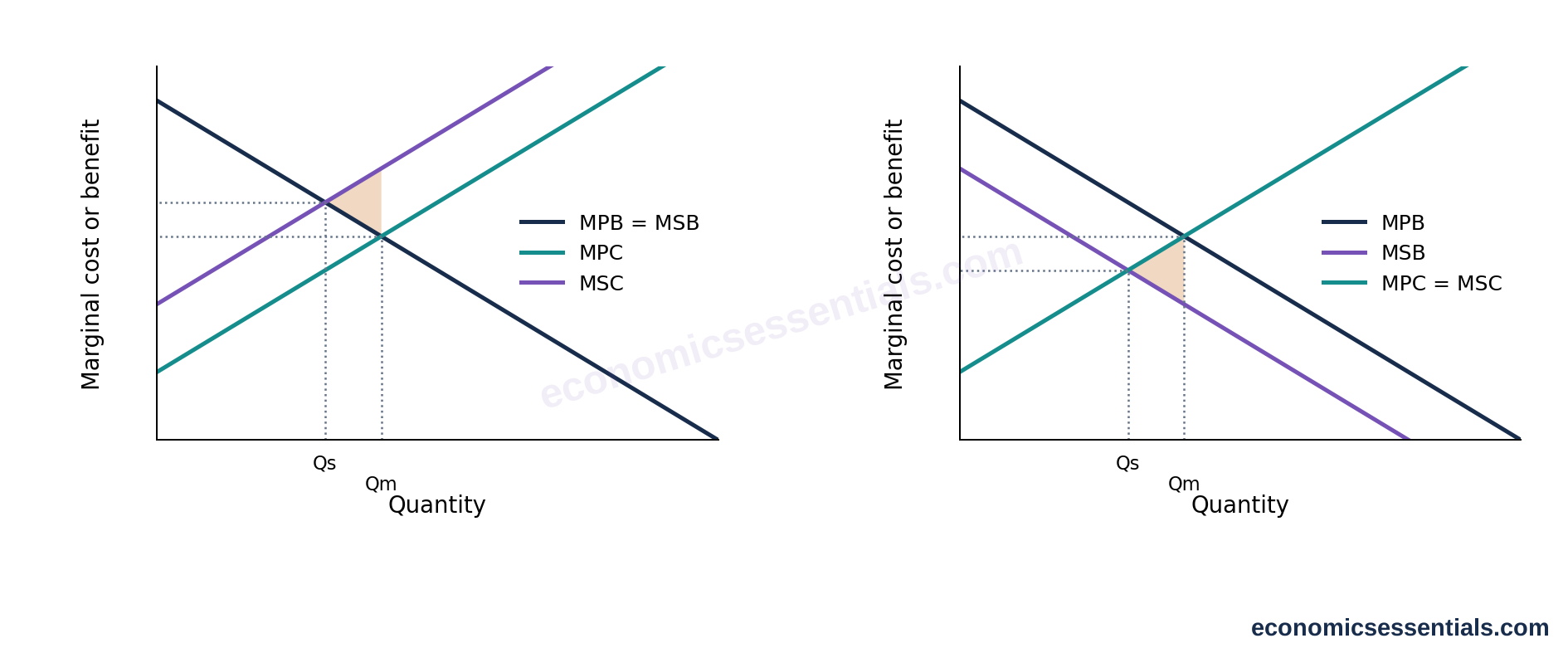
Production external costs place MSC above MPC. Consumption external costs place MSB below MPB. In both cases the market quantity exceeds the social optimum; the shaded triangle is welfare lost on the excessive units.
Avoid assuming every unpleasant effect is external. A higher price paid by buyers is usually a market transfer rather than an external cost. Identify the affected third party and the missing incentive clearly. Also distinguish market failure from a business failing financially: a loss-making firm is not by itself evidence of inefficient market allocation.
Evaluation centres on measurement and behaviour. External damage can vary by location, time and output, making the efficient tax difficult to estimate. Firms may innovate, relocate or conceal emissions. A welfare diagram identifies the direction of distortion, but choosing policy requires evidence about damage, enforcement costs and whether cleaner alternatives are available.
Key terms
- Market failure
- A market allocation that does not maximise social welfare.
- External cost
- A cost imposed on a third party outside a market transaction.
- Marginal social cost
- The additional private and external costs of one more unit.
- Social optimum
- The output where marginal social benefit equals marginal social cost.
- Welfare loss
- The reduction in total social surplus caused by inefficient allocation.