Free lesson · Edexcel Economics A · 2.6.3
Supply-side policies and sustainable capacity
Supply-side policies aim to increase productive potential or improve how efficiently resources are used. They can raise sustainable output and reduce inflationary pressure, but often take longer to work than demand management. The important distinction is between expanding capacity and simply increasing spending on existing output.
Market-based policies seek to strengthen incentives and competition. Lower marginal income-tax rates may encourage additional work, while business-tax changes can influence investment. Deregulation can reduce unnecessary entry costs; privatisation and competitive tendering may increase pressure to control costs. Labour-market reform can alter wage flexibility, employment incentives and the ease of hiring.
Interventionist policies involve direct public action. Education and training can improve skills; healthcare can increase effective labour participation; transport, energy and digital infrastructure can reduce bottlenecks. Public support for research can address knowledge spillovers, while childcare or mobility assistance can help people enter jobs. The categories overlap: a government-funded training programme can improve how a market works.
Worked example: a manufacturer produces 10,000 units using 1,000 labour hours, so labour productivity is ten units per hour. Training and better equipment raise output to 12,000 with the same hours, increasing productivity to twelve units per hour, a 20% rise. If hourly pay is unchanged, labour cost per unit falls by one sixth, approximately 16.7%, rather than by 20%.
On an AD–AS diagram, stronger productive potential shifts LRAS right. Lower unit costs may also shift SRAS right. With unchanged demand, equilibrium can feature higher real output and a lower price level. Public investment initially also raises AD, so short-run price effects depend on the balance between spending and the later capacity improvement.
An increase in productive potential
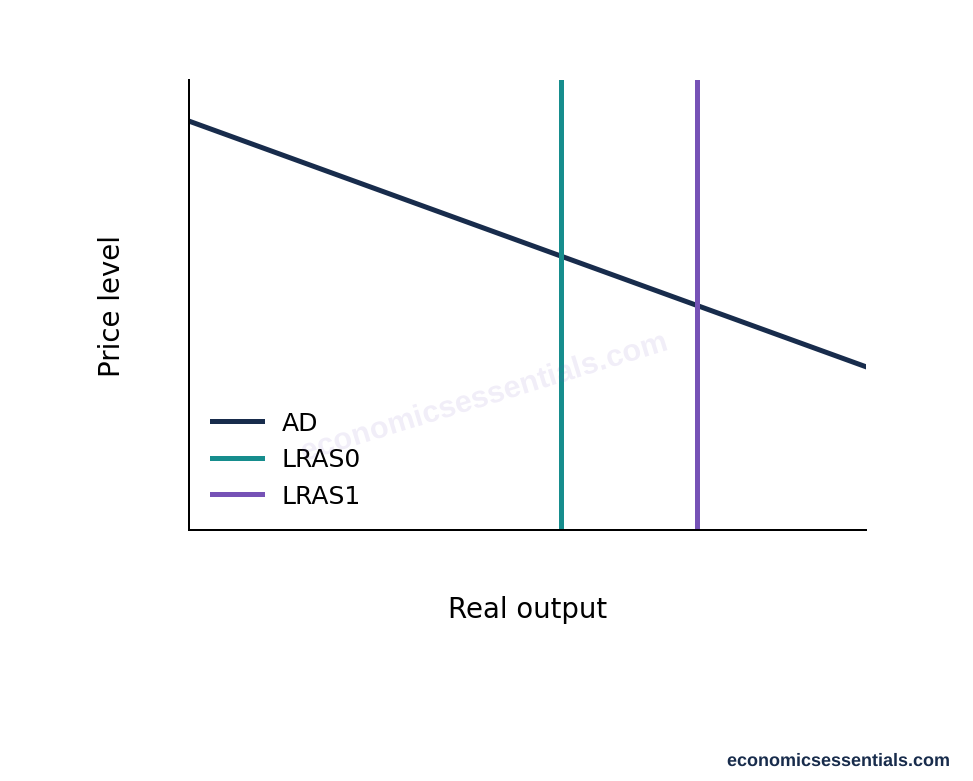
The rightward LRAS shift increases sustainable output. With the illustrated AD unchanged, the long-run equilibrium has higher real output and a lower price level.
Benefits include improved competitiveness, higher potential wages and fewer bottlenecks. Better matching of skills to vacancies can reduce structural unemployment. Competition can strengthen innovation, although firms also need access to finance and reasonable prospects of recovering research costs. Improvements in supply can make it easier to achieve growth and low inflation together.
Evaluation must examine costs, timing and unintended effects. Tax reductions may mainly reward activity that would already occur, and lower revenue can restrict public investment. Training may fail if courses do not match employers’ needs. Deregulation can worsen pollution or safety when existing rules correct market failure. Infrastructure projects can overrun and use resources with valuable alternative uses.
A convincing judgement identifies the binding constraint. If firms lack skilled workers, training may be more effective than a general tax cut. If demand is severely depressed, extra capacity alone may remain unused. The strongest package combines credible long-run improvements with sufficient demand, while monitoring whether productivity gains reach workers, consumers and the wider economy.
Key terms
- Supply-side policy
- A policy intended to improve productive capacity or the functioning of markets.
- Human capital
- Skills, knowledge and health embodied in workers.
- Deregulation
- Removing or reducing rules restricting economic activity.
- Labour mobility
- Workers’ ability to move between locations or occupations.
- Productivity
- Output per unit of input, such as output per worker-hour.