Free lesson · Edexcel Economics A · 2.6.2
Monetary policy and the Bank of England
Monetary policy influences spending and financial conditions through interest rates and the supply of money. In the UK, the Bank of England’s Monetary Policy Committee, or MPC, sets monetary policy to pursue its inflation remit. Members assess evidence, discuss risks and vote on decisions. The policy rate affects wider borrowing and saving rates, although the transmission is neither immediate nor complete.
A rate reduction can lower loan and mortgage costs, reduce the reward for saving and make more investment projects worthwhile. Asset prices may rise as future income is discounted at a lower rate. A weaker exchange rate may support net exports but raise import costs. These channels can shift AD right, increasing real output where capacity is available and inflation pressure where it is scarce.
Worked example: a business considering a £100,000 loan faces annual interest of £8,000 at 8% and £5,000 at 5%, ignoring fees and repayment schedules. The £3,000 reduction can make an investment more attractive. However, if expected sales collapse, cheaper finance may still not justify the project. The example illustrates one channel rather than predicting total investment.
Quantitative easing, or QE, involves central-bank asset purchases financed by newly created central-bank reserves. Buying bonds tends to raise their prices and lower yields, encouraging investors towards other assets and easing wider financial conditions. It is not simply handing equivalent cash directly to every household, and an increase in reserves does not guarantee proportionate new bank lending.
Contractionary monetary policy raises rates or tightens financial conditions to restrain demand and inflation. Savers may gain higher interest income, while borrowers face higher costs. Distributional effects vary with debt, assets and contract terms. Fixed-rate mortgages delay the impact for some households, so policy works with variable lags.
Demand management and equilibrium
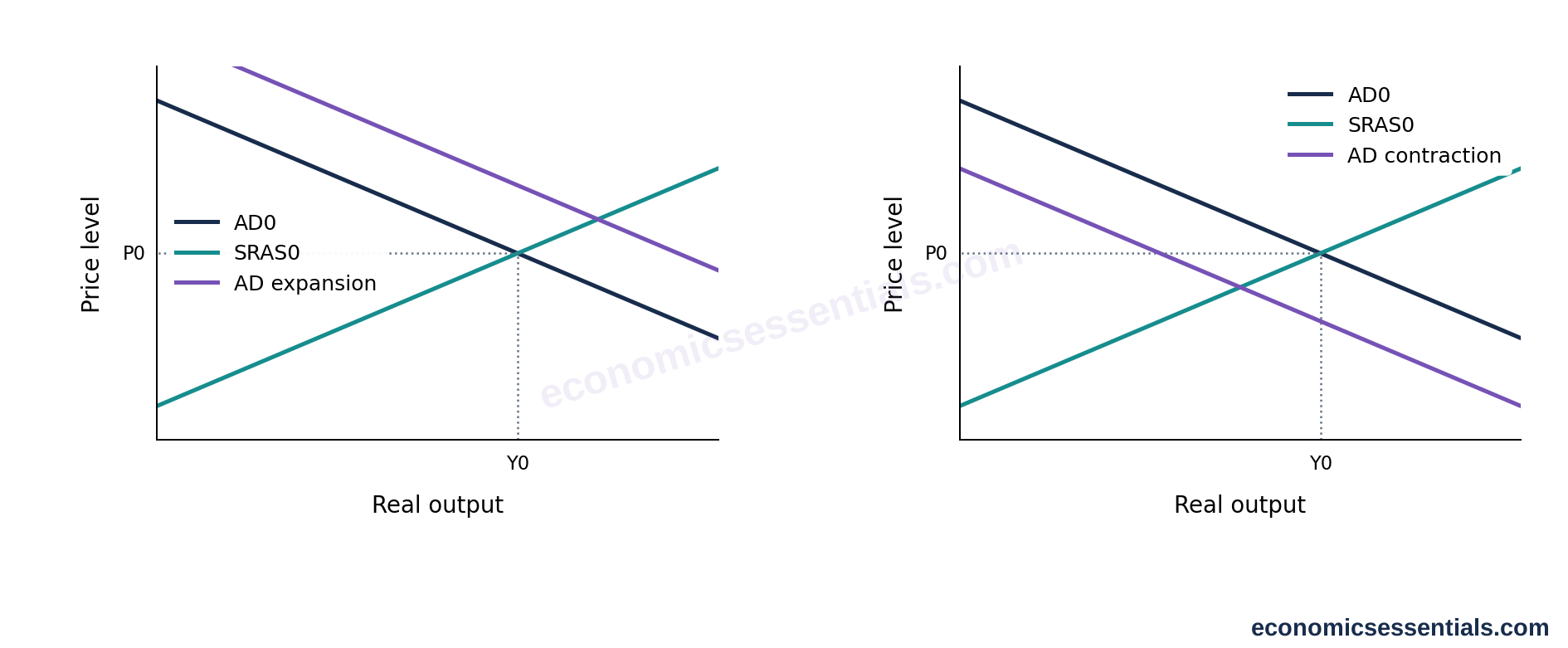
Expansionary fiscal or monetary policy can shift AD right; contractionary policy can shift it left. These diagrams hold SRAS constant. The real-output effect depends on spare capacity and the shape of aggregate supply.
During the 2008 crisis, UK and US central banks cut policy rates sharply and later used large-scale asset purchases. These actions sought to support demand and financial functioning after severe disruption. They operated alongside fiscal measures and bank interventions, making it difficult to isolate any single policy’s contribution. The Great Depression also shows how banking distress and monetary contraction can intensify a downturn.
Evaluation distinguishes demand pressure from supply shocks. Higher rates cannot directly produce cheaper energy, but may limit second-round inflation and expectations. The cost can be weaker output and employment. At very low rates, confidence, creditworthiness and banks’ willingness to lend may constrain stimulus. A strong conclusion considers the shock, transmission channels, expectations and the balance between stabilising inflation and avoiding unnecessary damage to activity. Use dated evidence when discussing a particular rate decision rather than assuming today’s settings will remain unchanged.
Key terms
- Monetary policy
- Central-bank action affecting interest rates, money and financial conditions.
- Bank Rate
- The Bank of England’s principal policy interest rate.
- Quantitative easing
- Central-bank asset purchases financed by creating reserves.
- Transmission mechanism
- The channels through which a policy change affects spending, output and prices.
- Liquidity trap
- A situation in which very low interest rates weaken the effectiveness of further conventional monetary expansion.