Free lesson · Edexcel Economics A · 2.6.4
Policy trade-offs and the Phillips curve
Economic policy rarely improves every objective simultaneously. Stimulating demand can raise growth and employment but increase inflation and imports. Tightening policy to reduce inflation can weaken spending and raise unemployment. These trade-offs are conditional: they depend on the source of the problem and the economy’s available capacity.
The short-run Phillips curve shows an inverse relationship between unemployment and inflation under given expectations and supply conditions. Stronger demand can encourage firms to hire more workers while bidding up wages and prices. A movement along a particular short-run curve can therefore represent a demand-driven trade-off. It is not a guaranteed menu available permanently to policymakers.
Worked example: suppose stimulus reduces unemployment from 7% to 5% while inflation rises from 2% to 4%. This is consistent with movement along a short-run Phillips curve if other conditions remain stable. If an energy shock instead raises inflation to 6% while unemployment rises to 8%, the curve has shifted outward. The second outcome cannot be explained as movement along the original curve.
Expectations help explain why the trade-off may change. If workers and firms start expecting higher inflation, wage and price setting can adjust. Sustaining output above capacity becomes harder, and attempts to keep unemployment artificially low may require accelerating inflation. Supply improvements can shift the relationship favourably by reducing bottlenecks and structural unemployment.
The short-run Phillips curve
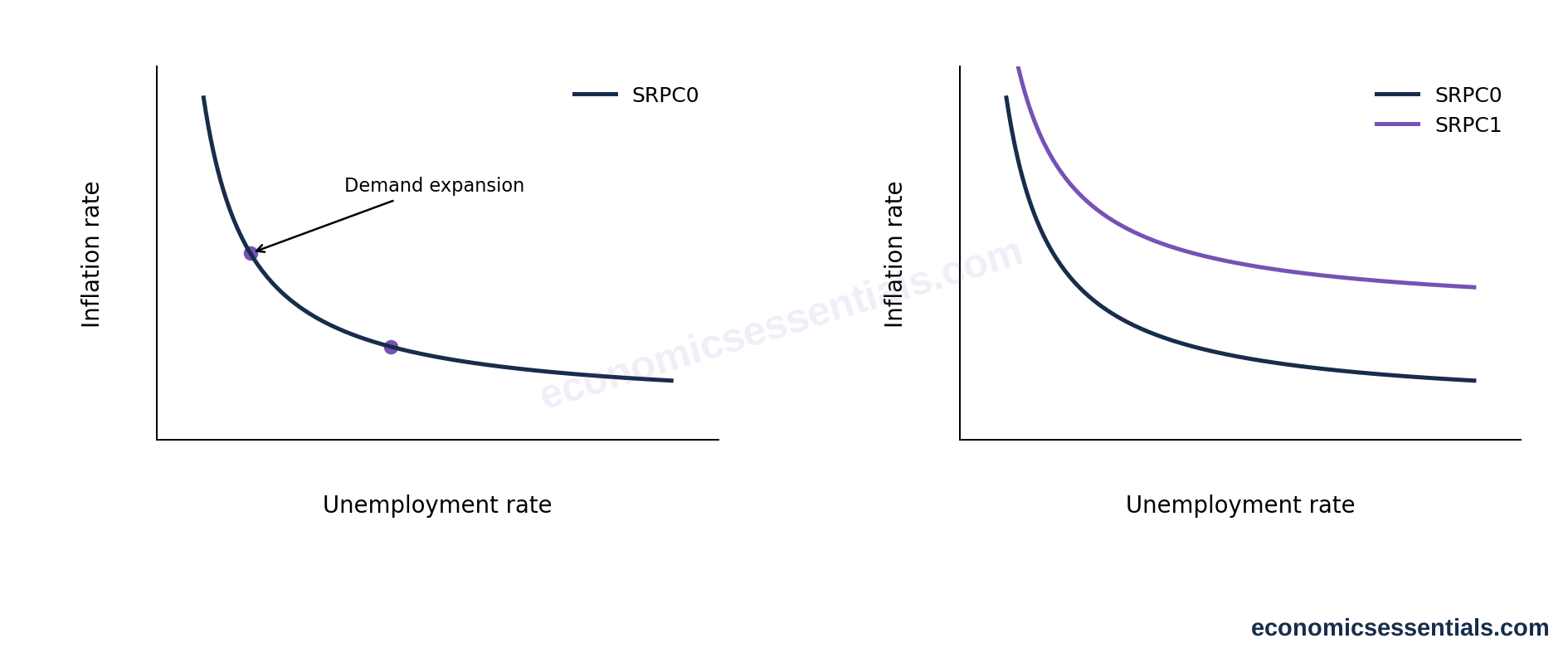
A demand-driven expansion can move an economy towards lower unemployment and higher inflation along a given short-run curve. A supply shock or changing expectations can shift the curve. The relationship is conditional, not a permanent policy menu.
Other objective conflicts include growth versus environmental protection, deficit reduction versus public-service provision, and efficiency incentives versus greater equality. However, these are not inevitable in every situation. Cleaner innovation can support growth with lower emissions. Better education can improve productivity and reduce inequality. Reducing waste can strengthen public finances without equivalent reductions in useful services.
Policy instruments can also conflict. Fiscal expansion may lead a central bank to keep interest rates higher to contain inflation, offsetting part of the stimulus. An interest-rate rise may support the currency and reduce import-price inflation but weaken exporters’ competitiveness. A depreciation may help exports while raising firms’ imported-input costs. The exchange-rate channel connects domestic and global objectives.
Evaluation should establish the starting point. With a large negative output gap, additional demand may mainly raise real output. Near capacity, the same stimulus creates more inflation. After a supply shock, policymakers may face an especially difficult combination of rising prices and falling output.
A reasoned recommendation prioritises objectives explicitly, considers the policy mix and explains the time horizon. Short-run support for vulnerable households can coexist with longer-run investment in capacity. The final judgement should state which conflict is most important in the given context, what evidence supports that view and how the proposed policy reduces its cost rather than merely listing competing objectives.
Optional extension beyond the named short-run requirement
Going further: the long-run Phillips curve
In the expectations-augmented model, a sustained attempt to hold unemployment below its natural rate changes inflation expectations. As wages and prices adjust, the short-run Phillips curve shifts rather than allowing a permanent demand-driven reduction in unemployment.
The long-run Phillips curve is drawn vertically at the natural rate of unemployment: the equilibrium rate associated with frictional and structural factors in this model. It is not zero, fixed forever or directly observable. Better matching, skills or labour-market institutions may change it. The model distinguishes a temporary demand stimulus from a lasting improvement in the functioning of the labour market.
This is useful evaluative context, but Edexcel 2.6.4 explicitly names the short-run Phillips curve. Do not present the extension as a guaranteed empirical law or confuse the natural rate with the actual unemployment rate at a particular date.
Key terms
- Short-run Phillips curve
- A conditional inverse relationship between inflation and unemployment.
- Policy trade-off
- Improving one objective involves sacrificing another under the relevant conditions.
- Inflation expectations
- Beliefs about future inflation that influence current decisions.
- Stagflation
- Weak economic activity or high unemployment alongside high inflation.
- Natural rate of unemployment
- The equilibrium unemployment rate associated with structural and frictional factors in the long-run model.