Free lesson · Edexcel Economics A · 2.3.1, 2.3.2, 2.3.3
Short-run and long-run aggregate supply
Aggregate supply, or AS, describes the output firms are willing and able to produce at different general price levels. Short-run aggregate supply usually slopes upwards because some input costs are slow to adjust: higher selling prices can make additional production profitable. A change in the price level causes a movement along SRAS; changes in underlying production costs shift it.
Higher energy, raw-material or wage costs relative to productivity shift SRAS left. Lower business taxes or cheaper inputs can shift it right. A currency depreciation may increase the domestic cost of imported materials, weakening SRAS even while improving export demand. These competing channels are important when evaluating exchange-rate changes.
Long-run aggregate supply concerns productive potential. The classical model draws LRAS vertically at potential output, reflecting the view that long-run real production depends on resources, technology and institutions rather than the general price level. A higher price level alone does not create more skilled workers or machines once all prices and wages adjust.
The Keynesian AS curve includes a relatively flat region at low output, an upward-sloping intermediate region and a steep or vertical region near capacity. With substantial spare resources, demand can expand output with limited inflation. Near full capacity, bottlenecks and competition for inputs make price increases more likely. The different shapes represent different assumptions about adjustment and spare capacity.
Classical and Keynesian aggregate supply
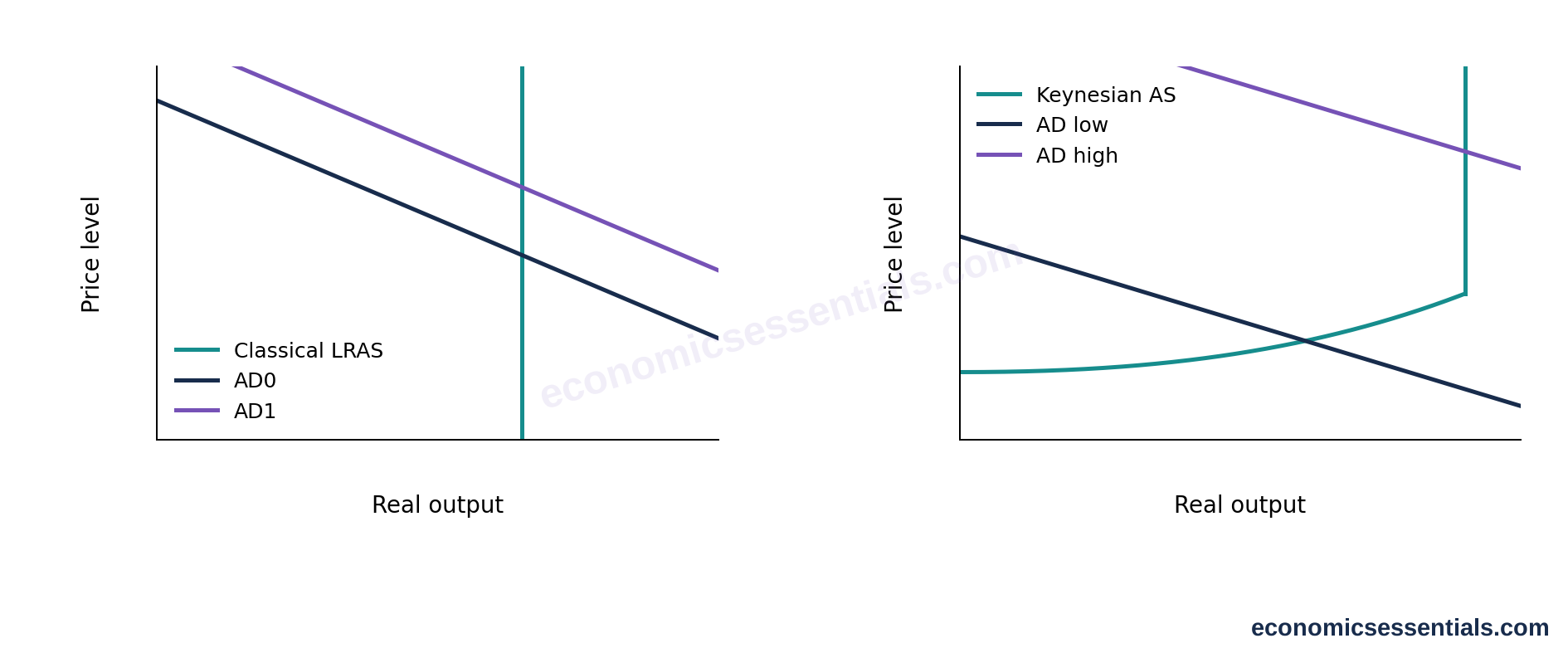
The classical long-run curve is vertical at potential output. The Keynesian curve is relatively flat with substantial spare capacity and steep near capacity. A demand increase therefore has different output and price effects depending on the starting position.
Worked example: an economy initially produces £500 billion of real output. A rise in imported energy costs makes producing that output more expensive, shifting SRAS left. With AD unchanged, equilibrium output falls and the price level rises. This is a supply shock, so weaker output and higher inflation occur together. Moving left along AD is the response, not the original cause.
Demand pull and cost push inflation
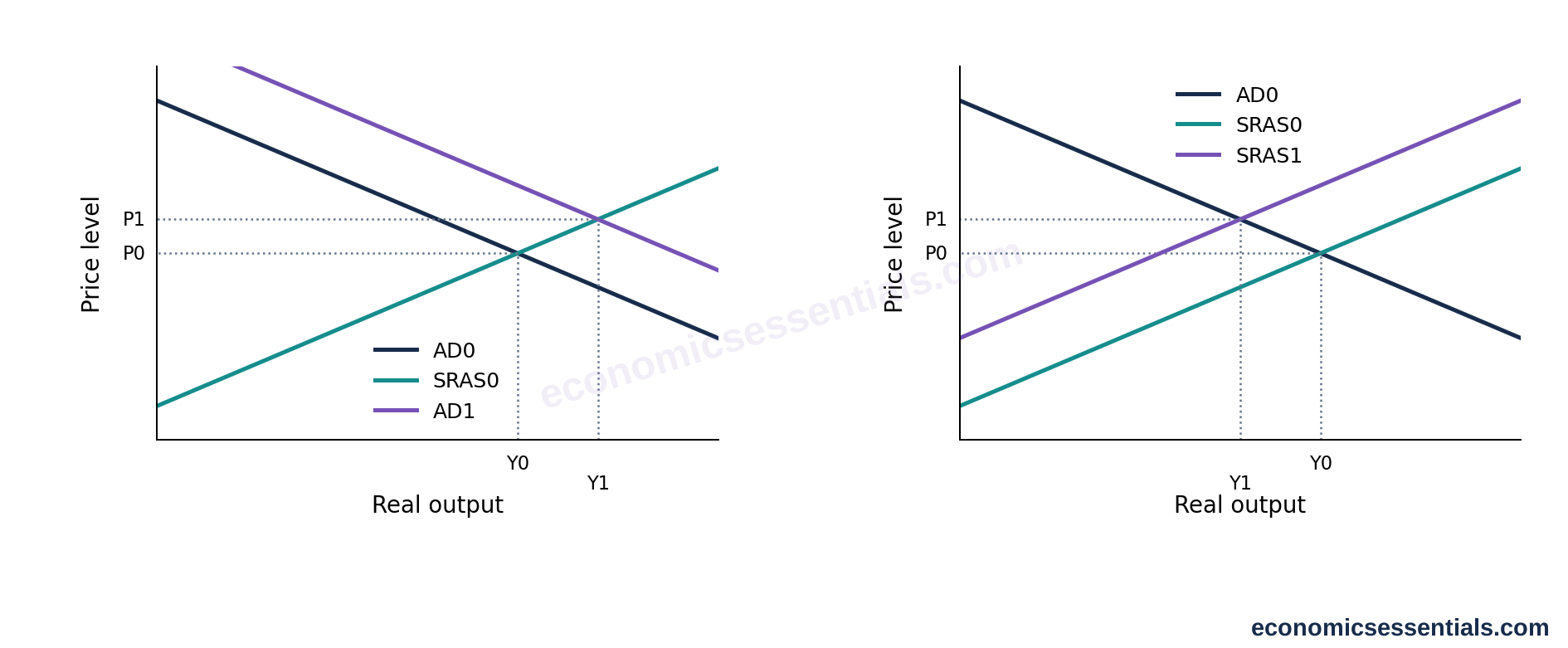
Left: stronger AD raises output and the price level. Right: higher production costs shift SRAS left, raising the price level while reducing output. These are alternative shocks, not simultaneous steps in one process.
Technological advances, education, skills, capital investment and better infrastructure can increase potential output. Migration and demographic changes alter labour availability. Competition policy and proportionate regulation can improve incentives and resource allocation. Relative productivity matters because domestic firms compete with producers elsewhere, not only with their own past performance.
Potential growth and output gaps
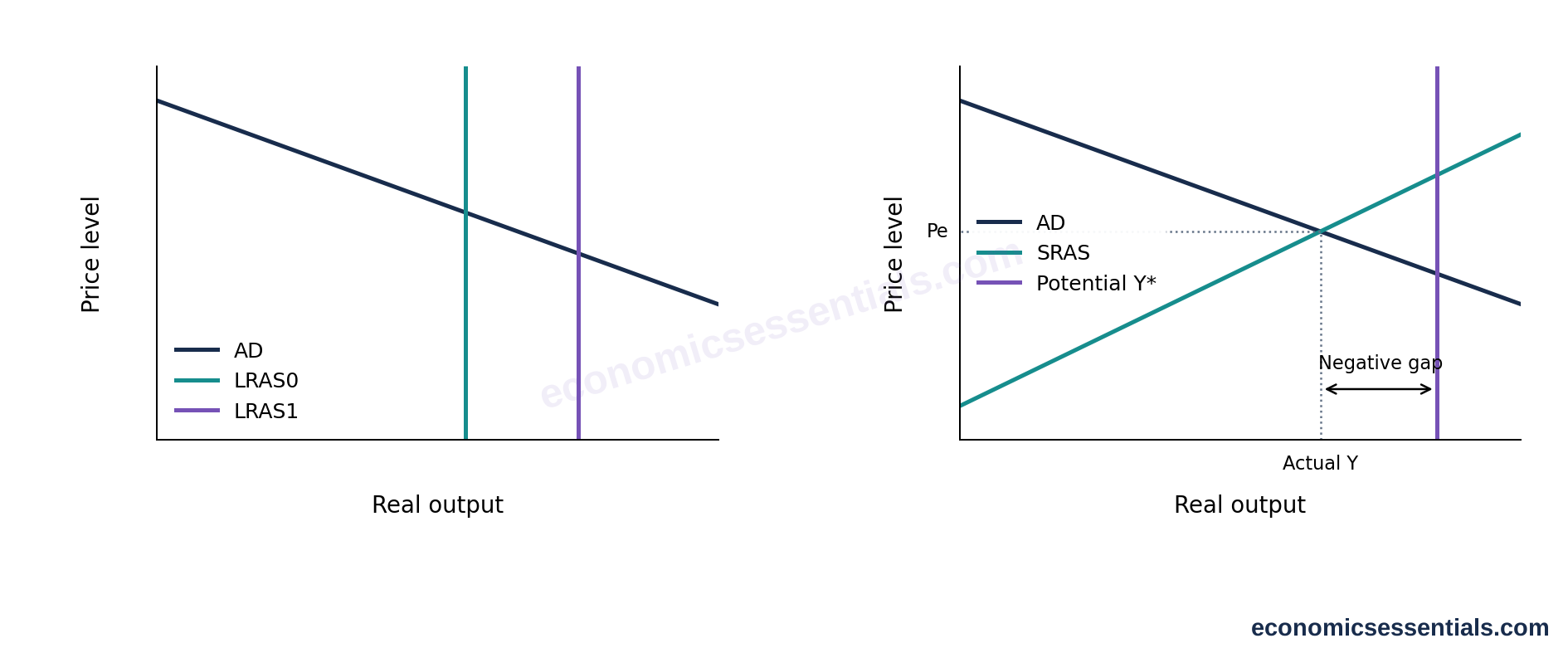
An outward LRAS shift raises productive potential. A negative output gap exists where actual output is below that potential, not merely where growth is slow. Demand is needed to use capacity; supply reform does not guarantee immediate full employment.
Evaluation focuses on the distinction between demand and capacity. Retraining may raise long-run supply but requires spending now and takes time to deliver results. Deregulation may reduce costs but can weaken protection where rules address genuine externalities or information gaps. A larger labour force does not guarantee greater output if complementary capital and jobs are absent.
Use the diagram to state a conditional outcome. A rightward LRAS shift allows more sustainable real output and, with unchanged AD, may reduce the price level. It does not guarantee that all extra capacity will be used immediately. Demand, investment and supply policies often need to reinforce one another.
Key terms
- Short-run aggregate supply
- The output firms will supply at different price levels while some input prices are fixed.
- Long-run aggregate supply
- The relationship between the price level and sustainable output once input prices can adjust.
- Productive capacity
- The output an economy can sustainably produce using its resources and technology.
- Cost-push inflation
- Inflation associated with higher production costs and a fall in aggregate supply.
- Supply shock
- An unexpected change affecting production costs or productive capacity.