Free lesson · Edexcel Economics A · 2.4.1, 2.4.2, 2.4.3, 2.4.4
Circular flow, equilibrium and the multiplier
Households supply labour and other factors to firms, receive income and spend on output. Firms receive sales revenue and pay factor incomes. This circular flow links production, income and expenditure. Income is a flow measured over time; wealth is a stock of accumulated assets minus liabilities at a particular date.
An open economy adds withdrawals and injections. Saving, taxation and imports withdraw spending from the domestic flow. Investment, government purchases and exports inject spending. In the simplified equilibrium condition, planned injections equal planned withdrawals: I + G + X = S + T + M. If injections exceed withdrawals, firms may expand output and incomes until additional withdrawals restore balance.
The multiplier explains why an autonomous spending increase can generate a larger final change in real income. One person’s spending becomes another’s income, which supports further spending. Each round becomes smaller because part of the additional income is saved, taxed or spent on imports. The multiplier ratio is the final change in real income divided by the initial injection.
Worked example: a £100 million infrastructure order becomes wages and business income. If 60% of each additional pound is spent on domestic output, the successive spending rounds are £100 million, £60 million, £36 million and so on. The multiplier is 1 ÷ (1 − 0.6) = 2.5, giving a theoretical total income increase of £250 million.
In an open economy with proportional leakages, MPW = MPS + MPT + MPM. If the marginal propensities to save, tax and import are 0.15, 0.15 and 0.10, MPW = 0.40 and k = 1 ÷ 0.40 = 2.5. Marginal propensities measure changes in each item relative to additional income, not the average share of total income. The formula 1/(1 − MPC) requires a consistent definition and the relevant simplified assumptions; do not ignore taxes and imports when the question supplies them.
Circular flow and the spending multiplier
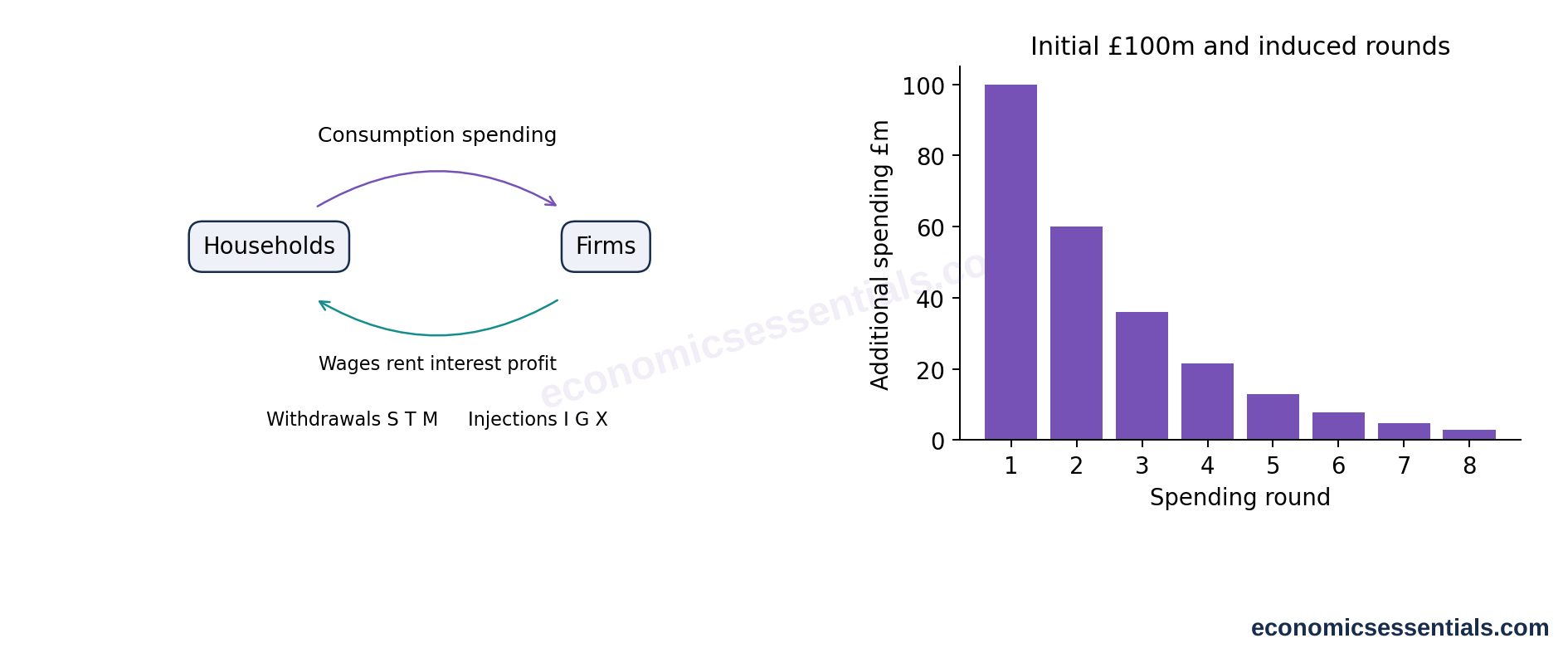
Money flows from households to firms as consumption and returns as factor income. Saving, tax and imports are withdrawals; investment, public purchases and exports are injections. In the multiplier panel, each induced spending round is 60% of the previous one.
Macroeconomic equilibrium also occurs where AD equals AS. A larger injection shifts AD right; the multiplier process can reinforce the initial demand change. However, a rise in nominal spending is not guaranteed to create an equally large real-output increase. Near capacity, prices rise and imports may absorb demand.
Demand management and equilibrium
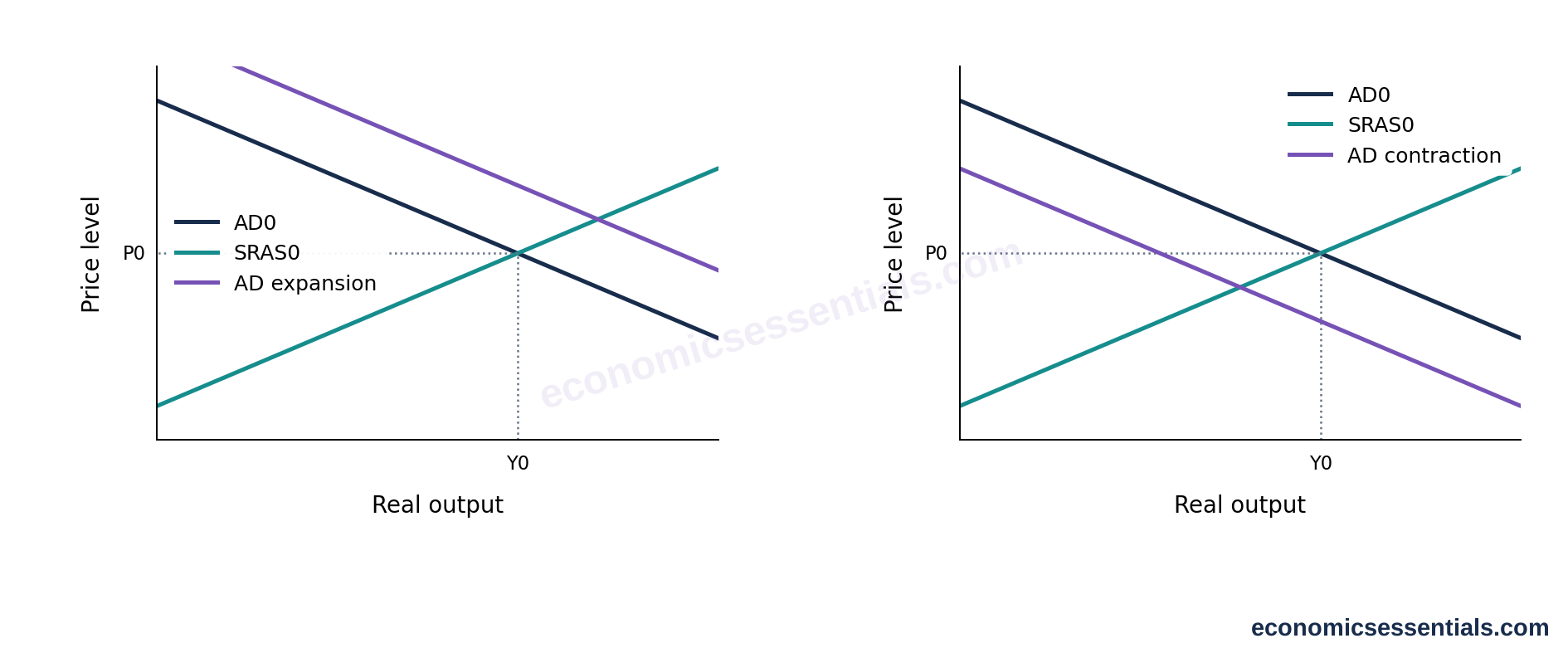
Expansionary fiscal or monetary policy can shift AD right; contractionary policy can shift it left. These diagrams hold SRAS constant. The real-output effect depends on spare capacity and the shape of aggregate supply.
Evaluation should consider spare capacity, confidence, financing and time. Households may save more during uncertainty, reducing the multiplier. Higher interest rates or reduced private spending can offset government purchases. The process also works in reverse: an investment decline can cause a multiplied contraction. Explain the spending rounds and leakages before using the formula, so the calculation demonstrates a mechanism rather than becoming an isolated number.
Key terms
- Circular flow of income
- Flows of output, income and spending between economic agents.
- Injection
- Spending entering the circular flow through investment, government spending or exports.
- Withdrawal
- Income leaving the spending flow through saving, taxation or imports.
- Multiplier
- The ratio of the final change in national income to the initial change in autonomous spending.
- Marginal propensity to consume
- The fraction of additional disposable income spent on consumption.