Free lesson · Edexcel Economics A · 2.2.1, 2.2.2, 2.2.3, 2.2.4
Aggregate demand and its components
Aggregate demand, or AD, is total planned spending on an economy’s domestically produced output at different general price levels. Its components are consumption, investment, government purchases and net exports: AD = C + I + G + (X − M). Imports are deducted because some spending included in the other components purchases foreign output.
The AD curve slopes downwards partly because a lower domestic price level increases real purchasing power, can reduce interest-rate pressure and can improve the price competitiveness of domestic goods. A change in the price level causes a movement along AD. A change in another spending determinant shifts the curve. This is an economy-wide relationship, not simply the demand curve for one product.
Demand management and equilibrium
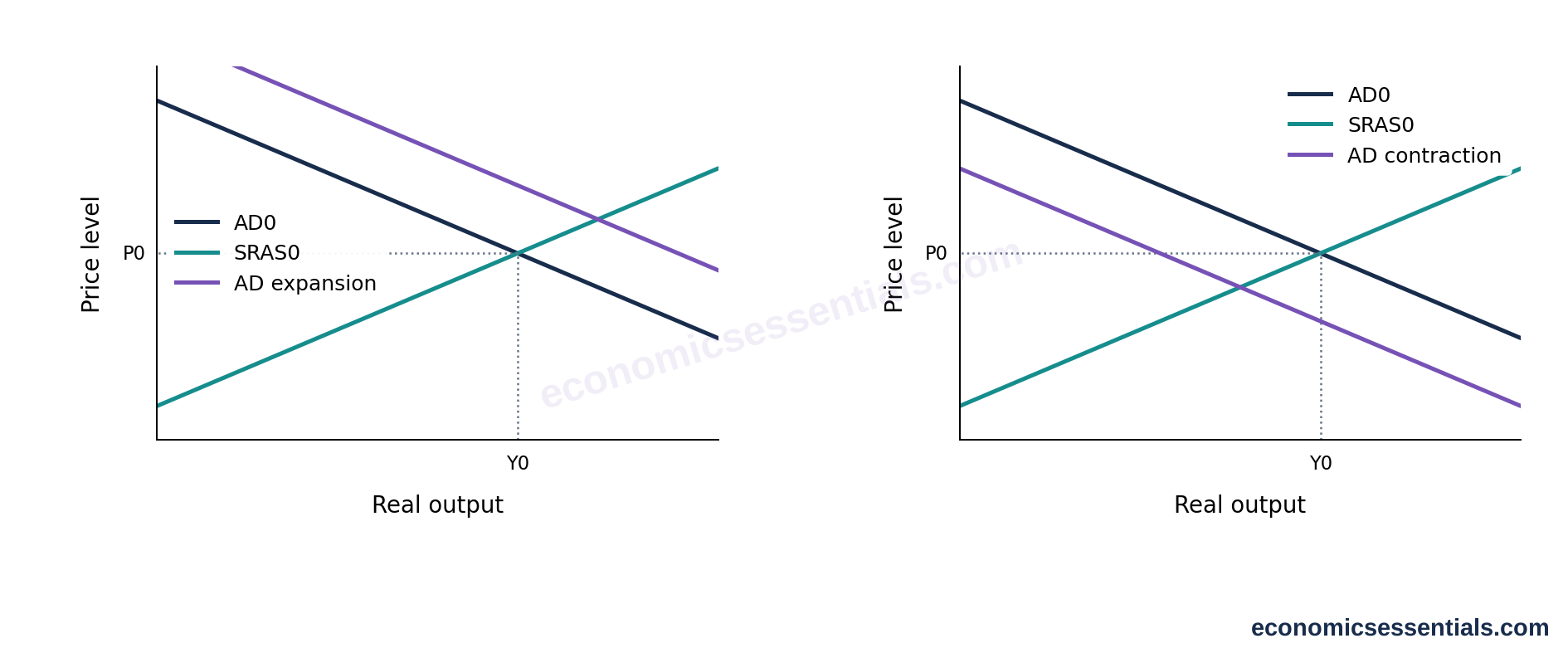
Expansionary fiscal or monetary policy can shift AD right; contractionary policy can shift it left. These diagrams hold SRAS constant. The real-output effect depends on spare capacity and the shape of aggregate supply.
Consumption depends strongly on disposable income, meaning income including transfers and after direct taxes. Households divide disposable income between consumption and saving. Lower interest rates reduce borrowing costs and the reward for saving, potentially increasing consumption. Confidence, access to credit and wealth also matter: higher house or share values may encourage spending, although asset-poor households gain less.
Investment means expenditure on capital goods, not the purchase of existing shares. Gross investment includes replacement of worn-out capital; net investment subtracts depreciation. Business expectations, output growth, export prospects, interest rates, credit availability and government regulation affect investment. Keynes used “animal spirits” to describe the confidence and sentiment that influence decisions under uncertainty.
Worked example: C = £600 billion, I = £150 billion, G = £200 billion, X = £180 billion and M = £130 billion. AD totals £1,000 billion, with consumption representing 60%. If investment falls £20 billion and consumption rises £10 billion, planned spending initially falls £10 billion, other things equal. Subsequent multiplier effects may amplify the output change.
Government purchases depend on fiscal choices and the business cycle. Spending on services and infrastructure contributes directly to AD. Transfer payments are not themselves government purchases of current output, although recipients may spend them and raise consumption. A downturn can increase benefit spending even without a new discretionary policy.
Evaluation should distinguish an initial spending change from its eventual effect on output. A large consumption sector can dominate demand, while a smaller but volatile investment sector can drive fluctuations. Households may save a tax cut, firms may postpone investment despite cheap credit, and extra demand may leak into imports. The final outcome also depends on aggregate supply: when spare capacity is scarce, stronger spending produces more inflation and less additional real output. Always identify the component changing and explain the behavioural link rather than saying simply that “confidence affects the economy.”
Key terms
- Aggregate demand
- Total planned spending on an economy’s output at different price levels.
- Consumption
- Household expenditure on goods and services.
- Investment
- Spending on additions to productive capital and stocks.
- Net exports
- Export receipts minus import expenditure.
- Accelerator effect
- Changes in demand or output growth causing changes in investment demand.