Free lesson · Edexcel Economics A · 3.3.4, 3.4.1
Profit, losses, shutdown and efficiency
Normal profit is the minimum return required to keep entrepreneurial resources in their current use. It is included in economic costs. A firm earning normal profit therefore has zero economic profit, even though its owners receive a return. Supernormal profit is revenue above all economic costs; a loss means revenue falls short of those costs.
At any chosen output, profit equals (AR − AC) × Q. Worked example: a firm sells 100 units at £8 with average total cost £6. Profit is (£8 − £6) × 100 = £200. If price falls to £5 and average variable cost is £4, it loses £100 relative to ATC of £6 but still contributes £100 towards fixed costs.
This explains the short-run shutdown rule. If revenue covers variable costs, continuing can reduce the loss from unavoidable fixed costs. A competitive firm shuts down if price is below minimum AVC; at equality it is indifferent under the basic model. A firm with downward-sloping demand compares the best attainable operating revenue with avoidable variable costs rather than mechanically applying one market price to every output.
Loss minimisation and temporary shutdown
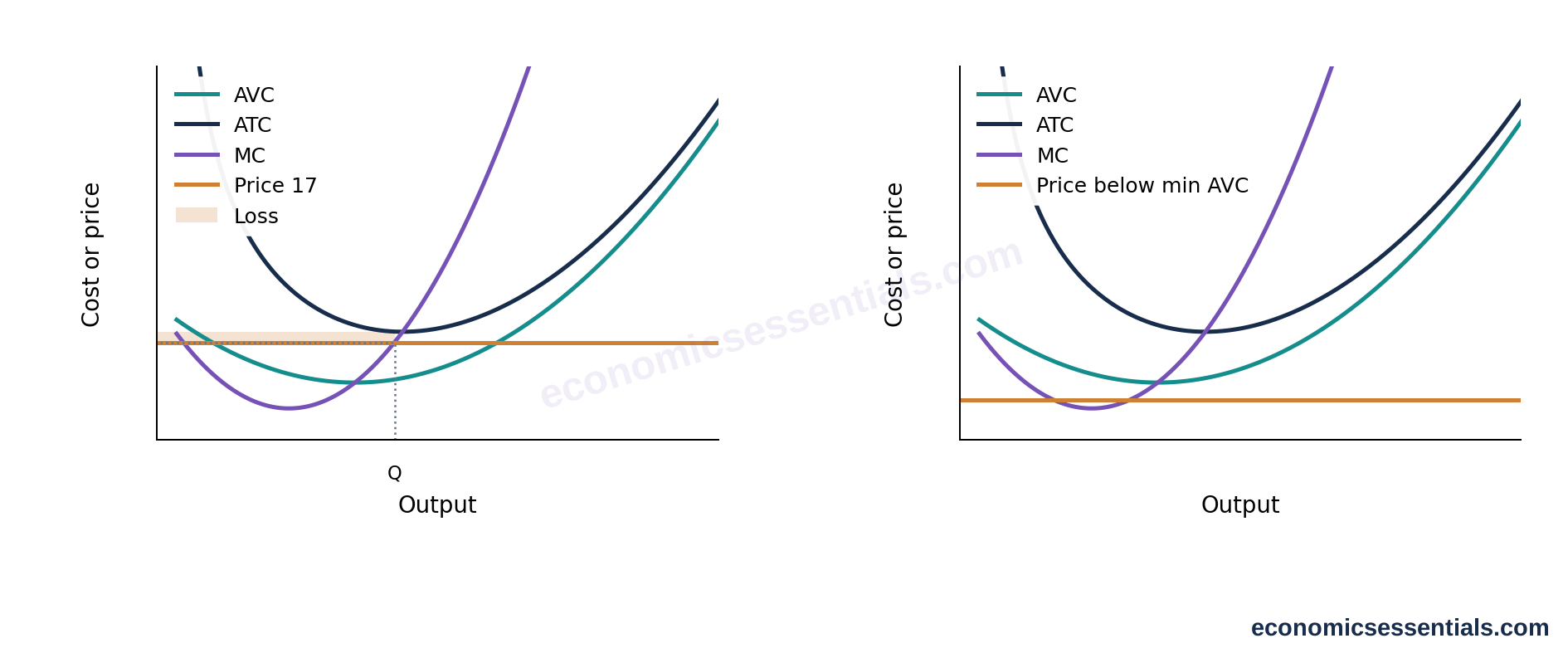
Left: at price 17, the competitive firm produces where MC equals price. The orange rectangle is its economic loss; revenue still exceeds variable cost. Right: a price below minimum AVC cannot cover variable costs, so stopping production avoids an additional operating loss.
In the long run, all costs are avoidable. A firm must expect to cover total economic costs to remain. The competitive long-run break-even price is minimum ATC. Distinguish shutting a plant temporarily from exiting the industry permanently. Expectations, contractual obligations and closure costs can influence the practical decision.
Competitive shutdown and break even
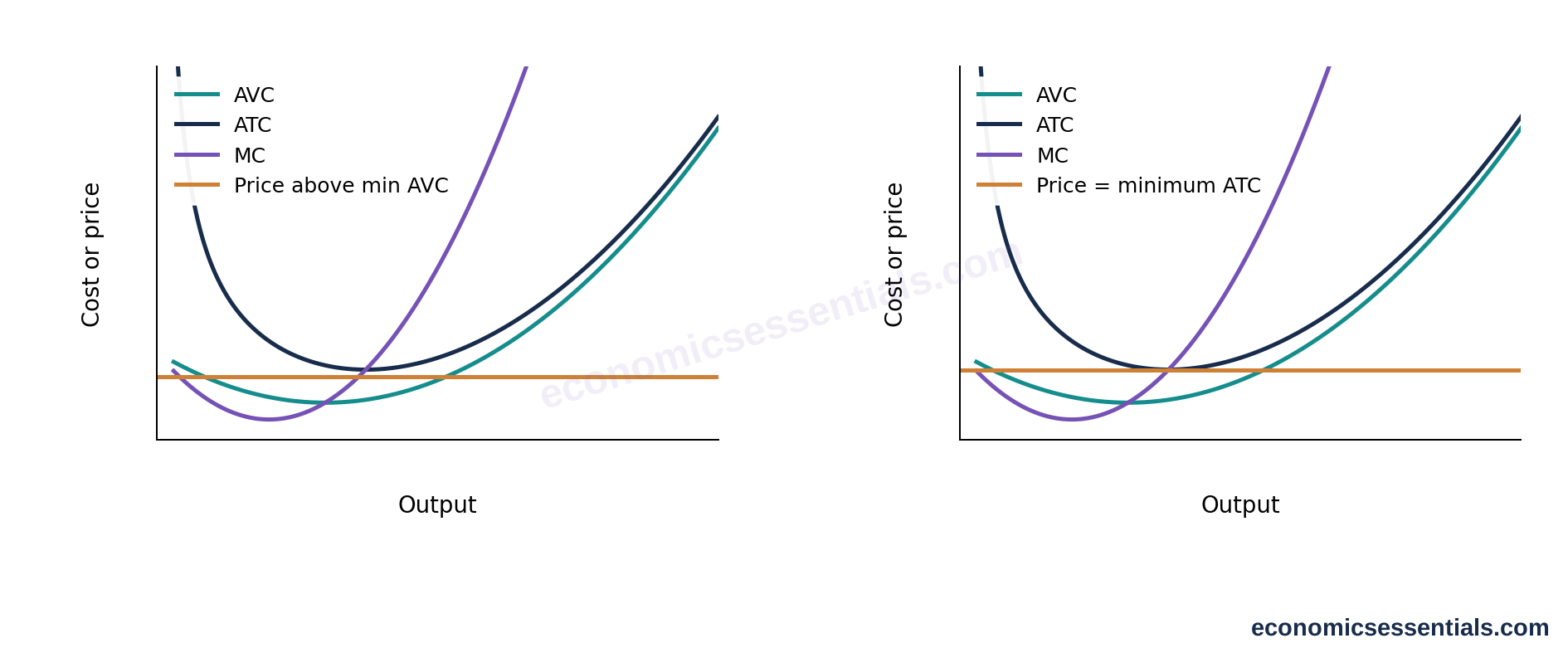
Left: price between minimum AVC and ATC can cover variable costs and part of fixed costs, so operating may minimise a short-run loss. Right: minimum ATC is the competitive long-run break-even point. Below minimum AVC, short-run shutdown is preferred.
Efficiency has several meanings. Productive efficiency means producing a given output at the lowest attainable cost; on the standard firm diagram it is associated with minimum AC. Allocative efficiency occurs where P = MC under the assumption that price measures marginal social benefit and MC includes all social costs. If externalities exist, private P = MC alone is insufficient.
Dynamic efficiency concerns improvements over time through innovation, investment and new products. X-inefficiency occurs when weak competitive pressure allows avoidable costs, so a firm operates above its attainable cost frontier. A firm can be technically large enough for scale economies yet still suffer managerial waste.
Evaluation involves trade-offs. A monopolist may restrict output and price above MC but use profits to fund innovation. A competitive industry may allocate resources efficiently under restrictive assumptions while individual firms lack funds for risky research. Neither dynamic efficiency nor waste follows automatically from a market label.
When interpreting a diagram, first locate output using the firm’s objective, then read price and AC at that same output. Shade profit or loss as a rectangle, not a triangle. Finally identify which efficiency concept is relevant. Saying simply that a market is “efficient” misses the distinction between current production costs, social allocation and future innovation.
Key terms
- Normal profit
- The minimum return needed to keep enterprise in its current use, included in economic costs.
- Supernormal profit
- Revenue exceeding all economic costs, including normal profit.
- Productive efficiency
- Producing at the lowest feasible average cost for the relevant scale and technology.
- Allocative efficiency
- Output where marginal social benefit equals marginal social cost.
- Shutdown condition
- In the short run a firm stops production if revenue cannot cover avoidable variable costs.