Free lesson · Edexcel Economics A · 3.3.2, 3.3.3
Costs, productivity and economies of scale
A firm’s costs depend on output, input prices and productivity. Total cost equals total fixed cost plus total variable cost. Fixed costs do not vary with current output in the short run; variable costs do. Average fixed cost is TFC/Q, average variable cost is TVC/Q and average total cost is TC/Q. Marginal cost is the change in total cost divided by the change in output.
Worked example: fixed cost is £100. At ten units, variable cost is £80, so total cost is £180, AFC £10, AVC £8 and ATC £18. At eleven units, variable cost rises to £92, making total cost £192. Marginal cost is £12. Because £12 is below the previous average total cost, the additional unit reduces ATC to approximately £17.45.
Diminishing marginal productivity helps explain short-run cost curves. With at least one fixed input, adding more workers eventually produces smaller increments of output. More variable input is then required for each extra unit, raising marginal cost. MC crosses AVC and ATC at their respective minimum points. AFC continually falls as fixed cost is spread across output.
Short run costs and long run scale
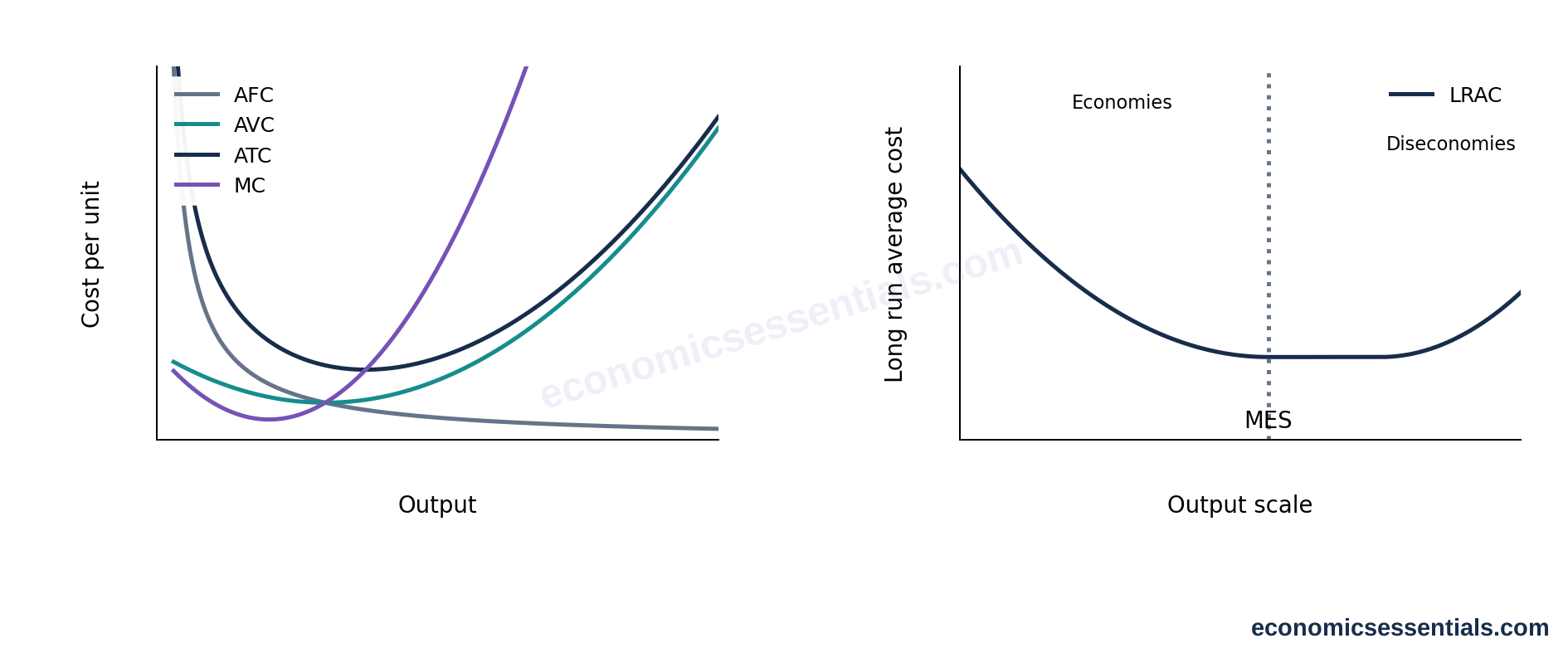
MC crosses AVC and ATC at their minima. AFC declines as output spreads fixed costs. On the right, long-run average cost falls with scale economies, reaches minimum efficient scale and then rises if diseconomies dominate.
In the long run all factors can vary. The long-run average cost curve represents the lowest attainable average cost for each output when the firm can choose its scale. It forms an envelope of relevant short-run cost curves; it does not connect every short-run minimum. Economies of scale occur when long-run average cost falls as output rises.
Short run plants and the long run envelope
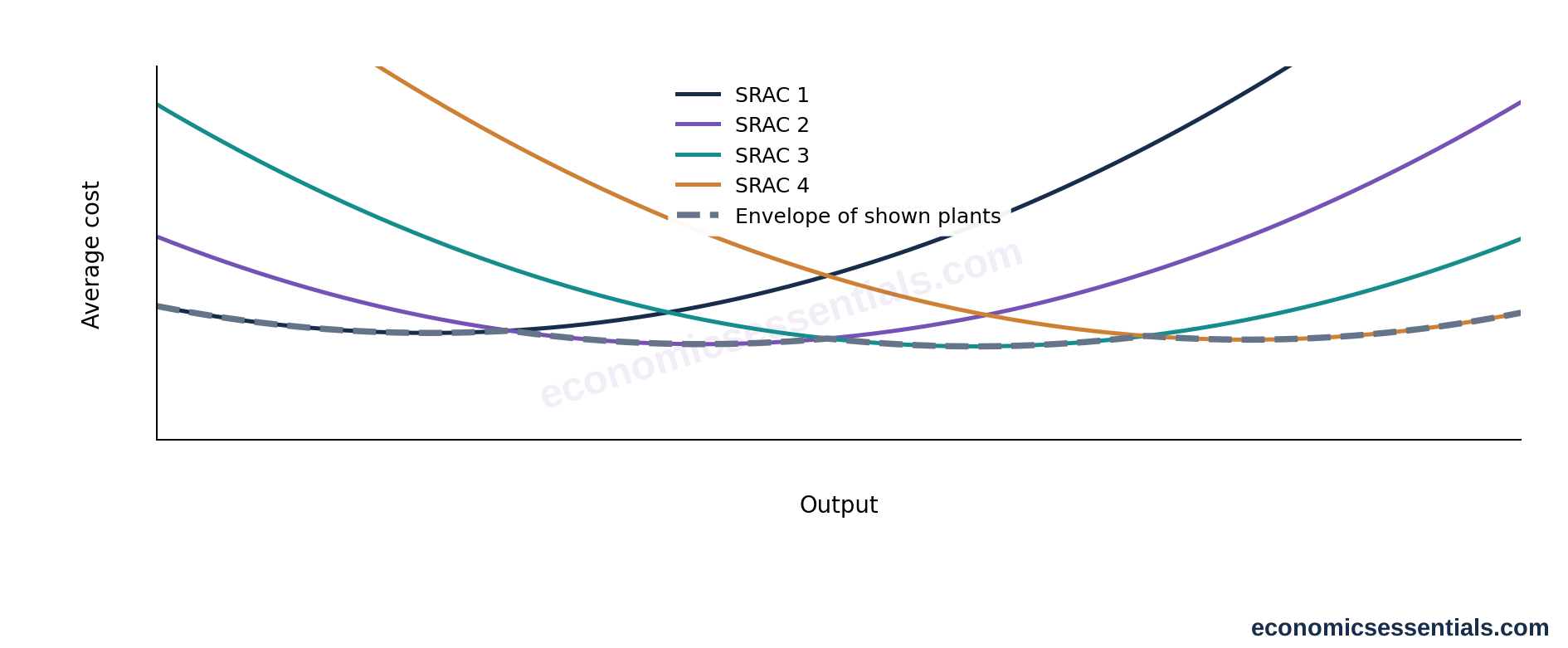
Each short-run plant has some fixed capacity. LRAC selects the lowest available average cost for each output across possible plant sizes. Only selected points on each short-run curve lie on the envelope; connecting all plant minima is generally incorrect.
Internal economies arise within the firm. Technical economies use larger or more specialised machinery; purchasing economies improve input terms; managerial economies allow specialist staff; financial economies may reduce borrowing costs; marketing economies spread advertising expenditure; risk-bearing economies diversify activities. Diseconomies can emerge through communication problems, coordination costs and weaker employee motivation.
External economies arise from industry expansion rather than one firm’s growth, such as specialised suppliers, a skilled local workforce or shared infrastructure. Industry congestion and competition for scarce land or workers can instead create external diseconomies. Distinguish these from externalities imposed on unrelated third parties: the terminology describes different analytical relationships.
Minimum efficient scale is the smallest output at which long-run average cost reaches its minimum. If MES is large relative to market demand, only a few efficient firms may fit, helping explain concentration. If MES is small, many firms may compete effectively.
Evaluation asks whether cost savings are achievable and passed on. Growth through acquisition can create integration costs that offset predicted economies. Digital technology may lower entry costs while also creating network advantages for established platforms. Cost curves simplify a changing business environment, so use them to explain mechanisms rather than assume that every large firm is efficient or every small firm is disadvantaged.
Key terms
- Fixed cost
- A cost that does not vary with output in the short run.
- Variable cost
- A cost that changes with output.
- Average cost
- Total cost divided by output.
- Marginal cost
- The change in total cost from producing one more unit.
- Economies of scale
- Falling long-run average costs as a firm expands its scale of output.