Free lesson · Edexcel Economics A · 3.4.2, 3.4.3
Perfect and monopolistic competition
Perfect competition is a benchmark with many buyers and sellers, identical products, good information and free entry and exit. Each firm is too small to influence the market price, so its demand curve is horizontal at that price. For the firm, P = AR = MR, even though the industry demand curve slopes downwards.
A competitive firm chooses output where MC = MR on the rising part of MC. In the short run it may earn supernormal profit or incur losses because market conditions and capacity are given. Supernormal profit attracts entry, increasing industry supply and reducing price. Losses encourage exit, reducing supply. In long-run equilibrium, price equals minimum ATC and firms earn normal profit under the benchmark assumptions.
Worked example: market price is £10 and a firm’s profit-maximising output is 200 units. If ATC is £8, economic profit is £400. Entry may eventually reduce price to £8, assuming that is minimum ATC under the relevant cost conditions. Do not shift the individual firm’s horizontal demand curve because its own output increases; it moves when the industry-determined price changes.
Perfect competition achieves productive and allocative efficiency in its standard long-run equilibrium: P equals minimum AC and MC. However, the assumptions are demanding. Real products differ, information is incomplete and entry can be costly. Very small firms may also struggle to finance large research projects, although competitive pressure can encourage innovation.
Perfect competition in the short and long run
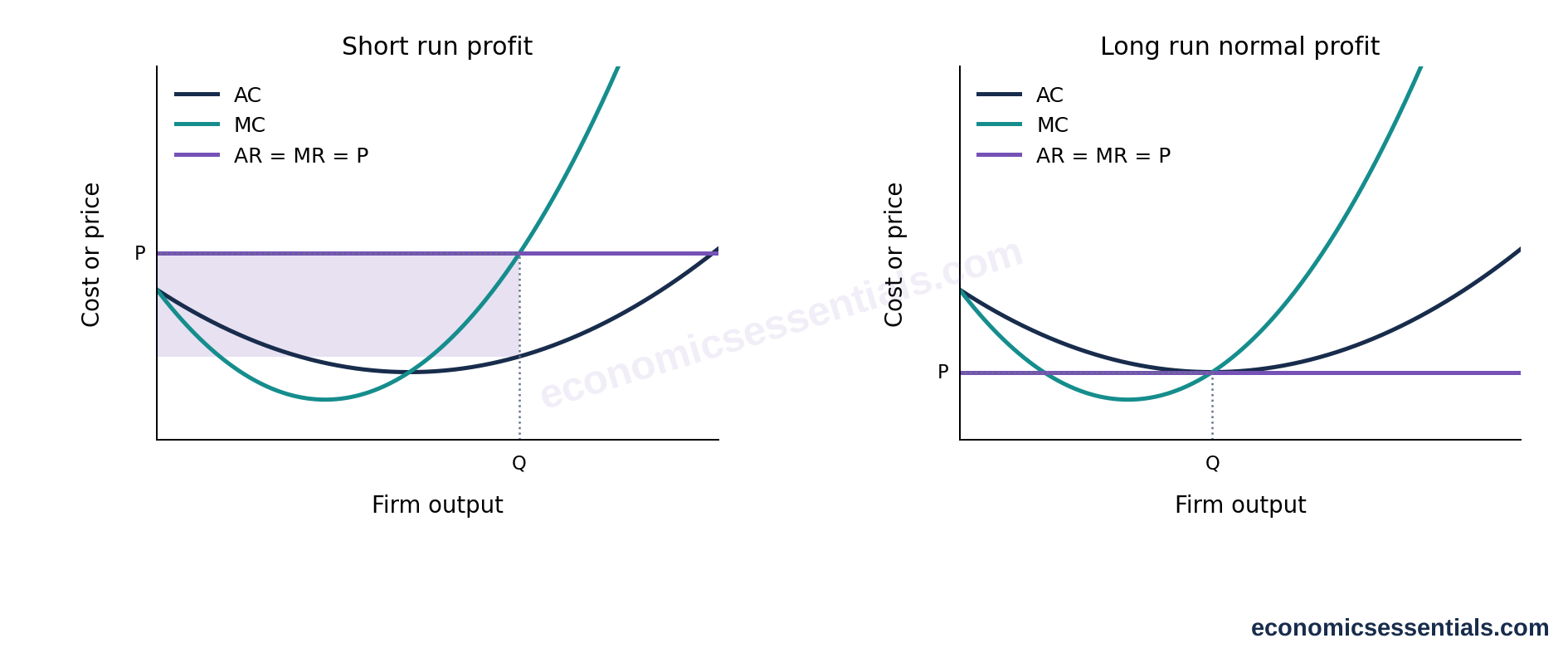
Short-run supernormal profit attracts entry under free-entry assumptions. Industry supply expands and price falls until the firm earns normal profit at minimum AC. The firm takes the industry price; its own demand is horizontal.
Monopolistic competition combines many firms and relatively easy entry with differentiated products. A café can have some price-setting power because of location, quality or branding. Its AR curve slopes downwards and MR lies below it. Profit maximisation still uses MC = MR, with price read from AR.
Short-run supernormal profit attracts close substitutes. Entry shifts each existing firm’s demand inward and may make it more elastic. Long-run equilibrium occurs where AR is tangent to AC at the profit-maximising quantity. Firms earn normal profit, but output is usually below the level minimising AC, creating excess capacity. Price exceeds MC, indicating allocative inefficiency in the basic model.
Monopolistic competition in the short and long run
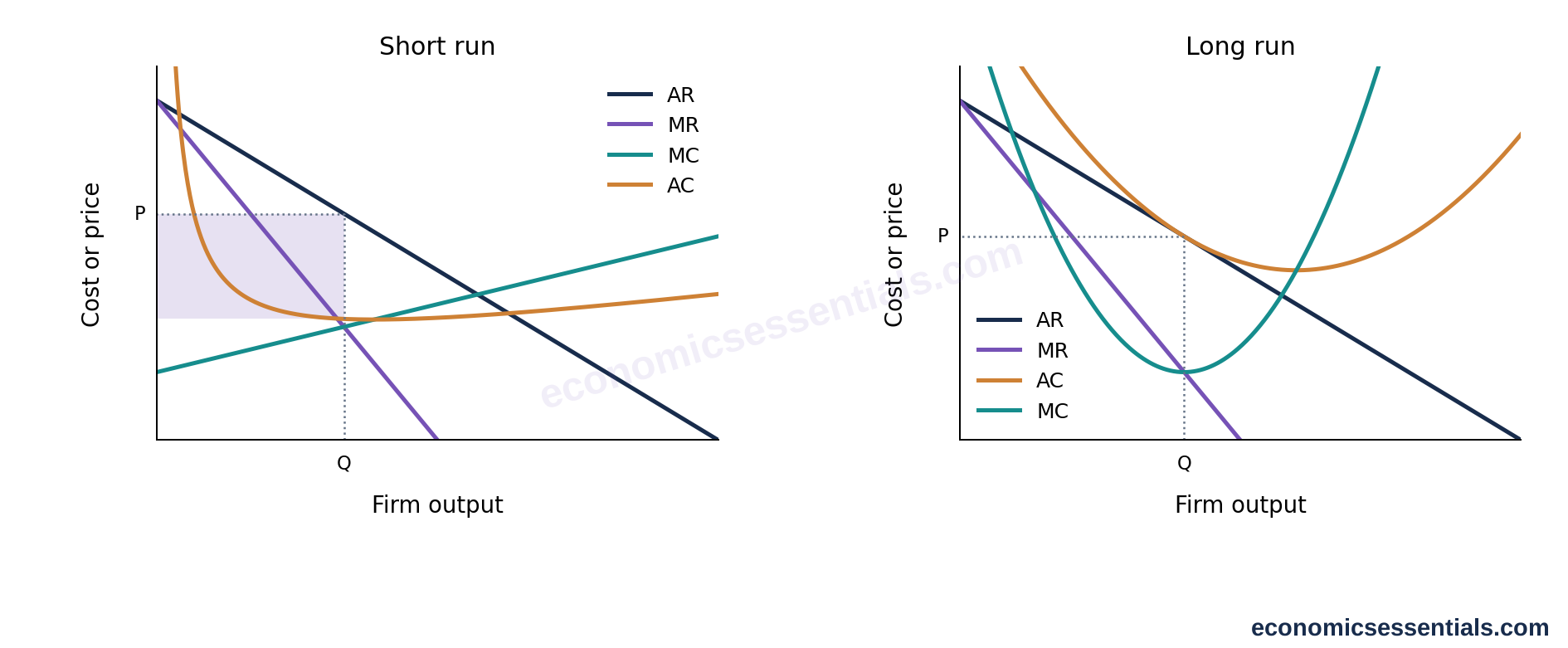
Entry of differentiated substitutes erodes supernormal profit. Long-run AR is tangent to AC at the profit-maximising quantity, but that quantity is below minimum AC. Normal profit therefore coexists with excess capacity and P greater than MC.
Evaluation weighs these costs against variety and convenience. Consumers may willingly pay more for preferred products, locations or service. Advertising can inform customers or create costly brand barriers. Product differentiation is therefore not simply waste, although it can weaken price competition.
Compare the structures using assumptions, entry, the shape of firm demand and equilibrium outcomes. Do not assume that normal profit proves productive efficiency: monopolistically competitive firms can earn normal profit while operating above minimum AC. The most useful judgement considers whether the benefits of variety and innovation outweigh the extra costs in the particular market.
Key terms
- Perfect competition
- A model with many price-taking firms, homogeneous products and free entry and exit.
- Monopolistic competition
- A model with many firms selling differentiated products and relatively free entry and exit.
- Price taker
- A seller unable individually to influence the market price.
- Product differentiation
- Features that make consumers perceive a product as distinct from rivals.
- Excess capacity
- Producing below the output that minimises long-run average cost.