Free lesson · Edexcel Economics A · 3.4.5, 3.4.6, 3.4.7
Price discrimination, monopsony and contestability
Why can a cinema charge different prices to students and other customers? Third-degree price discrimination means charging different prices to identifiable customer groups for the same product where the difference is not explained by corresponding cost differences. It requires market power, groups with different demand elasticities and the ability to prevent or limit resale.
A profit-maximising firm allocates output so that marginal revenue in each market equals the relevant marginal cost. The less price-sensitive group is generally charged more, under the usual conditions. Separate AR and MR curves show each market; comparing prices alone without the elasticity or marginal conditions misses the mechanism.
Worked example: in market A, P = 100 − Q, while in market B, P = 60 − Q. With constant MC of £20, market A has MR = 100 − 2Q, giving Q = 40 and P = £60. Market B gives Q = 20 and P = £40. Total output is 60. The example illustrates segmentation and optimal prices; it does not establish that discrimination always increases total output compared with one uniform price.
Third degree price discrimination
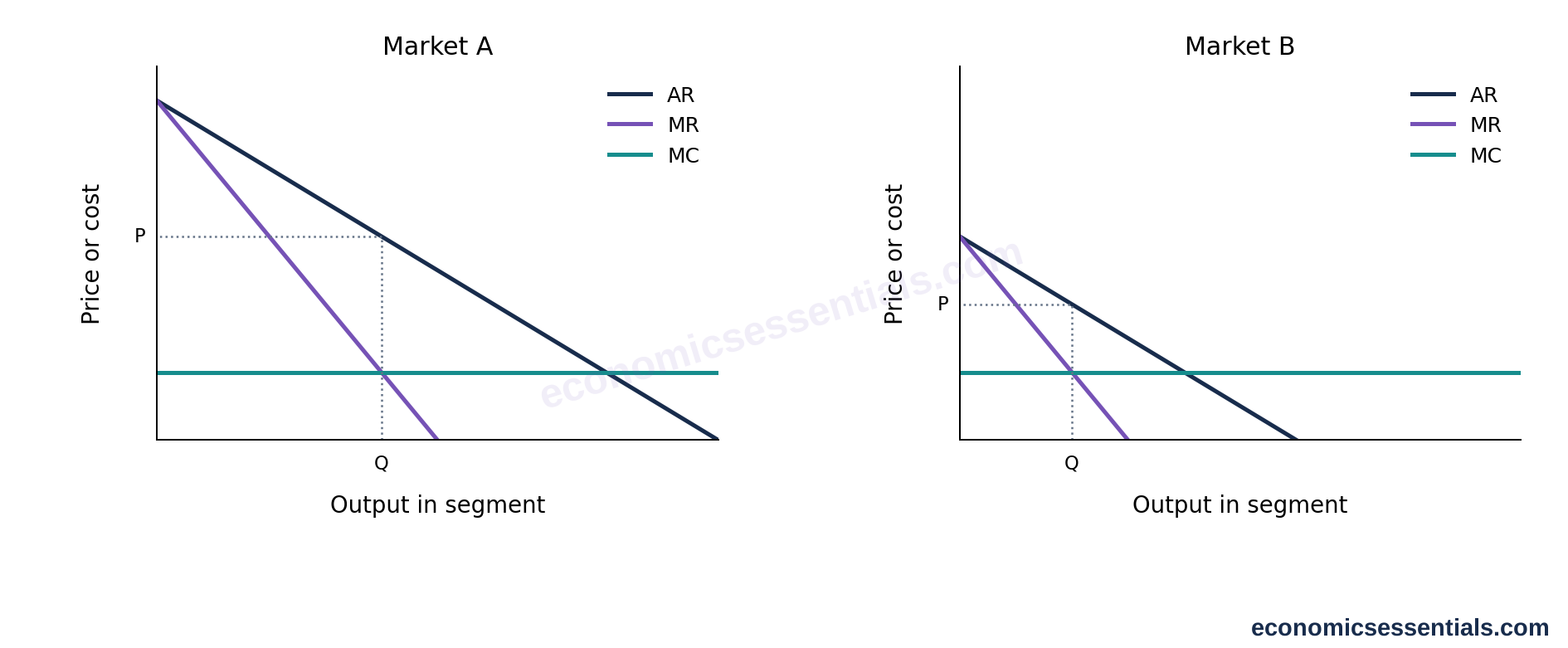
With constant marginal cost of 20, each market satisfies MR = MC separately. Market A is charged 60 at output 40; market B is charged 40 at output 20. Segmentation and limits on resale are necessary to sustain the price difference.
Some consumers gain access through lower prices, while others pay more and lose surplus. Firms can raise profit and may cover high fixed costs more easily. Welfare depends partly on whether total output increases and which previously excluded customers are served. Resale restrictions, administrative costs and perceptions of fairness also matter.
Monopsony is buyer power, in the pure case a single buyer. A dominant employer or supermarket can influence the terms offered to workers or suppliers. It may secure lower input prices, potentially reducing consumer prices, but suppliers can face squeezed margins and reduced investment. Workers may receive lower wages or face fewer alternatives. Outcomes depend on outside options and how savings are shared.
Contestability concerns the threat of entry and exit, not just the number of incumbent firms. A highly contestable market has low barriers, accessible technology and low sunk costs. Sunk costs cannot be recovered on exit, unlike equipment that can be resold. Potential “hit-and-run” entry can constrain incumbents even where current concentration is high.
Barriers include patents, licences, network effects, advertising, scale advantages and restricted access to distribution. Exit costs, such as specialised assets with little resale value, can deter entry before it begins. Limit pricing may aim to make entry unattractive, although credible cost advantages matter more than a temporary low price alone.
Evaluation connects the three ideas through power. Segmentation can increase a seller’s return, monopsony can improve a buyer’s bargaining position and contestability can discipline either. The final judgement should ask who has alternatives, whether entry is credible and whether lower costs or greater profits translate into improved output, quality and long-run investment.
Key terms
- Price discrimination
- Charging different prices for the same good where the difference is not explained by costs.
- Monopsony
- A market with a single buyer; monopsony power can also arise with a dominant buyer.
- Contestability
- The extent to which credible potential entry disciplines existing firms.
- Sunk cost
- A cost that cannot be recovered on leaving an activity.
- Arbitrage
- Buying in a cheaper market and reselling in a more expensive market.