Free lesson · Edexcel Economics A · 3.4.5
Monopoly, natural monopoly and welfare
A monopoly in the pure model is a single seller without close substitutes, protected by substantial entry barriers. Patents, legal restrictions, control of essential inputs, economies of scale, network effects and strong brands can all sustain market power. A firm’s power depends on substitutes and entry conditions, not simply its size.
A monopolist faces the market demand curve. To sell more at a single price, it must generally reduce the price on all units, so MR lies below AR. Profit maximisation occurs where MC = MR, and the selling price is read from demand at that output. Monopoly does not guarantee profit: demand may be weak or costs high.
Worked example: demand is P = 100 − Q and marginal cost is constant at £20. Then MR = 100 − 2Q. Setting MR = MC gives Q = 40 and price £60. If average total cost at that output is £30, profit is (£60 − £30) × 40 = £1,200. Under a competitive P = MC benchmark with the same cost, output would be 80 and price £20.
The standard welfare comparison shows restricted output, a transfer of surplus towards the producer and a deadweight loss from mutually beneficial trades not made. For the numerical example, the loss triangle is ½ × (80 − 40) × (60 − 20) = £800, assuming no externalities and the same costs. Monopoly profit itself is not the entire welfare loss; much of it is a transfer.
Monopoly profit and welfare
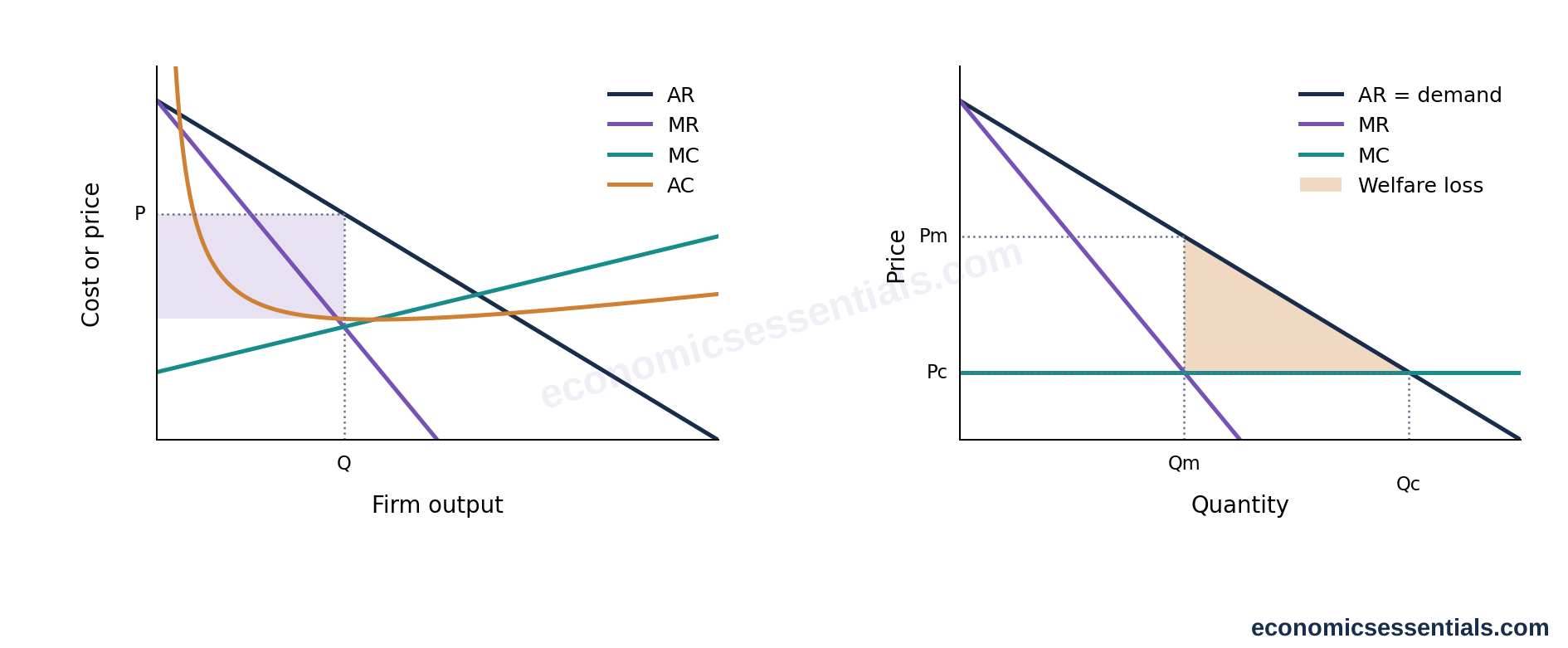
Left: the firm chooses Qm at MR = MC, then charges the AR price. Profit is the rectangle between price and AC at Qm. Right: with constant MC, output below the P = MC benchmark loses the shaded gains from trade.
Consumers may face higher prices and less choice. Suppliers or workers may face stronger bargaining pressure, while shareholders may receive greater returns. However, large scale can lower unit costs, support reliable networks and fund research. These benefits depend on incentives and governance: protected profits can also permit X-inefficiency.
A natural monopoly occurs when one firm can supply the relevant market at lower total cost than multiple firms, usually because average cost falls over the market’s demand range. Water networks are a useful conceptual example because duplicating pipes can be expensive. The relevant issue is the cost structure relative to market demand, not whether the product is essential.
Marginal-cost pricing can improve allocative efficiency but create losses where AC exceeds MC. Average-cost pricing can permit normal profit but produces less than the allocatively efficient output. Subsidy, regulation or public ownership may therefore be considered.
Natural monopoly and price regulation
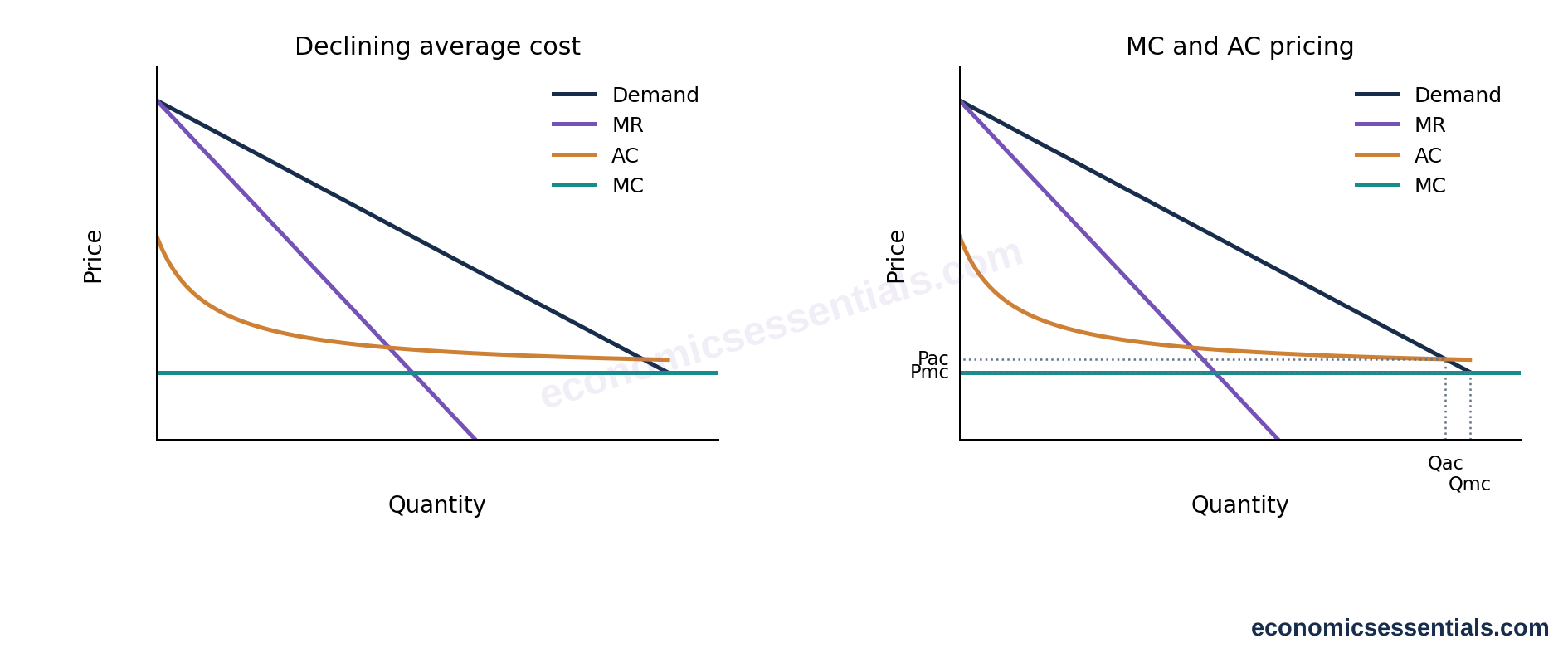
Falling AC over the market range makes duplication costly. Marginal-cost pricing reaches the efficient quantity but can leave AC above price and require subsidy. Average-cost pricing permits normal profit while leaving P above MC.
Evaluation compares realistic alternatives. Breaking up a natural monopoly can lose scale economies, while leaving it unregulated can permit exploitation. Innovation may come from entrants rather than incumbents. A strong conclusion examines costs, contestability, quality and investment rather than treating either monopoly power or public ownership as sufficient evidence of good or bad performance.
Key terms
- Monopoly power
- The ability to influence price or other market terms.
- Natural monopoly
- A market where one firm can serve relevant demand at lower cost than multiple firms.
- Barrier to entry
- An obstacle limiting entry by potential competitors.
- Dynamic efficiency
- Improvements in products or processes over time through investment and innovation.
- X-inefficiency
- Costs above the feasible minimum because competitive or managerial discipline is weak.