Free lesson · Edexcel Economics A · 1.4.1
Price controls and market intervention
Governments sometimes want prices to serve a social objective rather than simply clear a market. A maximum price is a legal ceiling, usually intended to improve affordability. It is binding only when set below equilibrium. A minimum price is a legal floor, often intended to support incomes or discourage consumption, and binds only above equilibrium.
A binding ceiling creates excess demand. At the controlled price, consumers want more while producers offer less. Some successful buyers benefit, but others face waiting lists, reduced quality or informal payments. A floor creates excess supply: producers want to sell more than consumers want to buy. A government may need to purchase surplus output if it promises to maintain the price through buying intervention.
Worked example: demand is Qd = 100 − 10P and supply Qs = 20 + 10P. Equilibrium is £4 and 60 units. A £3 ceiling creates demand of 70 and supply of 50, a shortage of 20. A £5 floor creates supply of 70 and demand of 50, a surplus of 20. Unless another buyer intervenes, actual transactions under the floor are constrained by the 50 units demanded, not the 70 offered.
Binding price ceilings and floors
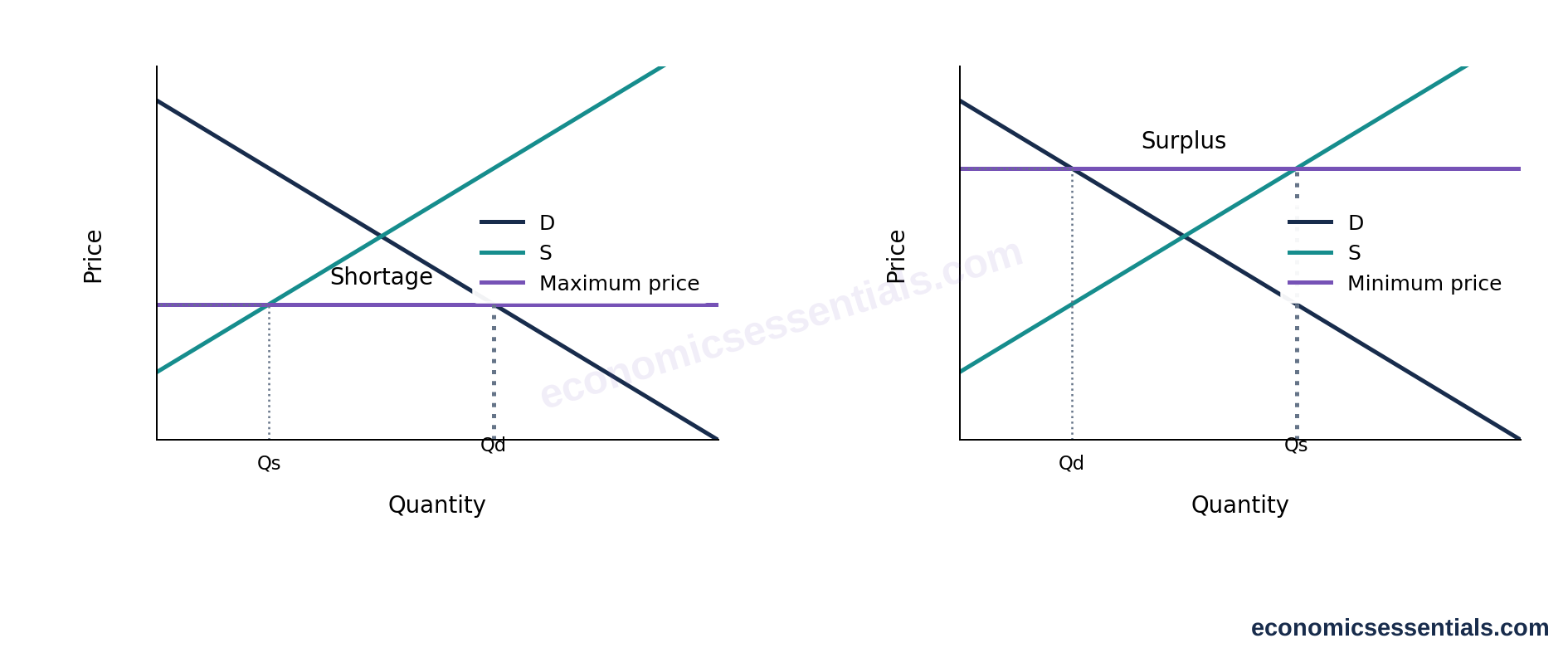
The ceiling is below equilibrium and creates a shortage. The floor is above equilibrium and creates excess supply. Unless another buyer intervenes, actual trade is constrained by the short side of each market.
Elasticities determine the size of shortages and surpluses. In a housing market, short-run supply may be relatively fixed, but a prolonged rent ceiling could discourage maintenance or new construction. Allocation also changes: landlords may select tenants using criteria other than willingness to pay. A non-binding control has no immediate effect on a freely adjusting equilibrium.
Governments also use indirect taxes and subsidies. A tax raises the private cost of a harmful activity; a subsidy lowers the effective cost of a beneficial one. State provision can supply public goods or services that markets underprovide. Information campaigns can correct misunderstandings, while regulation can set safety standards, prohibit harmful activities or require particular technologies.
The choice of instrument should match the problem. A ceiling may help some tenants afford rent without increasing the housing stock. A construction subsidy or planning reform may address supply but take longer. A minimum price for a harmful product may reduce consumption, but unlike a tax it does not automatically generate government revenue: some extra receipts go to sellers.
Evaluation must identify winners, losers and practical constraints. Enforcement costs, evasion, supply responses and public finance all matter. A well-targeted intervention may improve access or welfare, but combining policies can be necessary. Judge success against the stated objective: low prices for existing users, greater total access and long-run supply are different outcomes and may move in different directions.
Key terms
- Maximum price
- A legal ceiling above which a price cannot be charged.
- Minimum price
- A legal floor below which a price cannot be charged.
- Buffer stock
- A stock bought and sold to influence a commodity’s market price.
- Shortage
- Excess demand at the prevailing price.
- Government intervention
- Public action intended to change market outcomes.