Free lesson · Edexcel Economics A · 1.3.2, 1.3.3, 1.3.4
External benefits, public goods and information
Education can benefit the student through higher earnings while also helping other people through knowledge sharing and civic participation. These spillovers are external benefits. When private decision-makers ignore them, a market may produce or consume less than the socially efficient quantity.
For a positive consumption externality, MSB lies above MPB. Assuming no production externality, supply represents MPC = MSC. The market quantity Qm is determined by MPB = MPC, while the efficient quantity Qs occurs at MSB = MSC. The welfare loss from underconsumption lies between MSB and MSC over the missing units. For a positive production externality, such as useful knowledge spilling into other firms, MSC lies below MPC; do not shift the wrong curve.
Worked example: MPB = 80 − Q, MSC = 20 + Q, and marginal external benefit is £20. The market produces 30 units, while MSB = 100 − Q gives an efficient quantity of 40. Welfare loss is ½ × 10 × £20 = £100. A subsidy matching the external benefit at the efficient quantity could close the gap, provided recipients respond and the benefit estimate is reliable.
Positive externalities
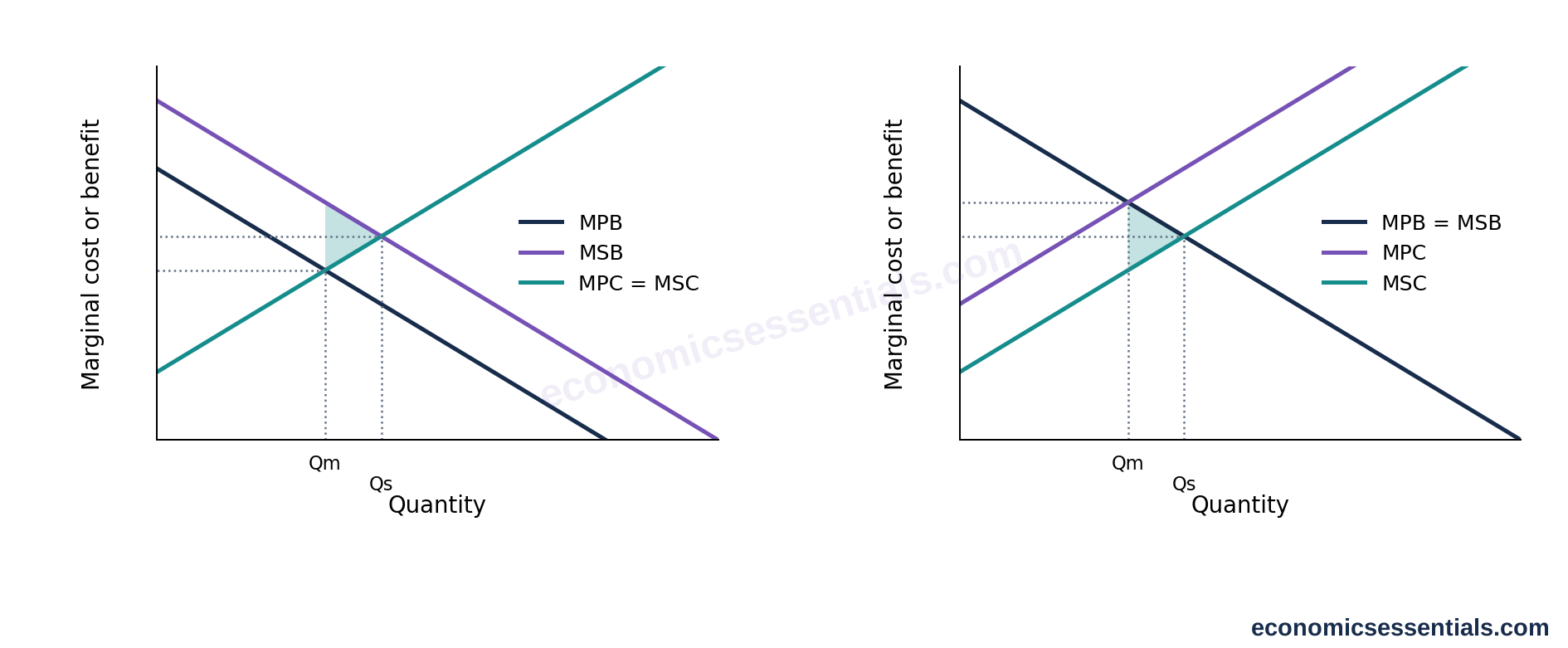
Consumption spillovers place MSB above MPB; production spillovers place MSC below MPC. The shaded area is the welfare gain available from expanding output from Qm to Qs, equivalently the welfare loss from leaving those beneficial units unproduced.
Public goods create another problem. They are non-rival, so one person’s use does not significantly reduce availability to another, and non-excludable, so preventing non-payers from benefiting is difficult. National defence is a standard example. Free riders can benefit without paying, weakening private incentives to supply the good. State provision funded through taxation can address this missing market.
A good is not public simply because the government provides it. A classroom place can be rival when capacity is full and students can be excluded. Some goods are quasi-public: a road may be non-rival when quiet but congested at peak times. Technology can change excludability, for example through electronic tolling.
Symmetric information means both sides have equivalent relevant knowledge. Information gaps can also distort choices. Consumers may underestimate long-term health damage or lack the knowledge to compare financial products. Asymmetric information means one side knows more than the other. A seller knowing more about a used car’s condition can undermine trust and deter worthwhile purchases. Information failure can produce overconsumption or underconsumption, depending on the missing knowledge.
Evaluation asks whether public provision, subsidies, disclosure or regulation addresses the actual cause. A subsidy alone may not persuade a misinformed consumer, and information alone cannot solve free riding. Quality is sometimes difficult to verify even after purchase. Better decisions require accessible information, credible providers and incentives to use that information. Government provision also uses scarce resources, so the relevant comparison is the expected welfare gain against financing, administration and displaced alternatives.
Key terms
- External benefit
- A benefit received by a third party outside a market transaction.
- Public good
- A good that is non-rival and non-excludable.
- Free rider
- Someone who benefits from a good without contributing to its cost.
- Asymmetric information
- One party to a transaction has more relevant information than another.
- Non-rivalry
- One person’s consumption does not reduce what is available to others.