Free lesson · Edexcel Economics A · 1.4.1
Pollution permits, regulation and policy design
If society wants less pollution, it can put a price on emissions, restrict them directly or create a market for emission rights. Tradable pollution permits combine a quantity limit with decentralised decisions about where reductions occur. The authority sets an overall cap, issues allowances and requires firms to surrender permits matching their covered emissions.
A firm that can reduce emissions cheaply may cut pollution and sell spare permits. A firm facing high reduction costs may buy permits instead. Trading encourages reductions where they are cheapest and tends to equalise marginal abatement costs. The permit price is determined by demand against the available supply; a tighter cap generally raises scarcity and the incentive to develop cleaner techniques.
Worked example: two factories each need to reduce emissions by ten tonnes under a uniform rule. Factory A can cut a tonne for £20 and factory B for £80. The total cost is £1,000. If A can instead cut all twenty tonnes at £20 each, meeting the same overall reduction costs £400. Trading at a price between £20 and £80 can make both firms better off than the uniform requirement. This example assumes constant abatement costs over the relevant range.
A tax fixes a price incentive but leaves the quantity response uncertain. A cap fixes covered emissions more directly but leaves the permit price uncertain. Auctioning allowances raises public revenue; giving them away transfers potential scarcity rents to recipients. Either arrangement still requires monitoring and penalties for non-compliance. A cap that is too generous creates little incentive to change.
The market for emissions allowances
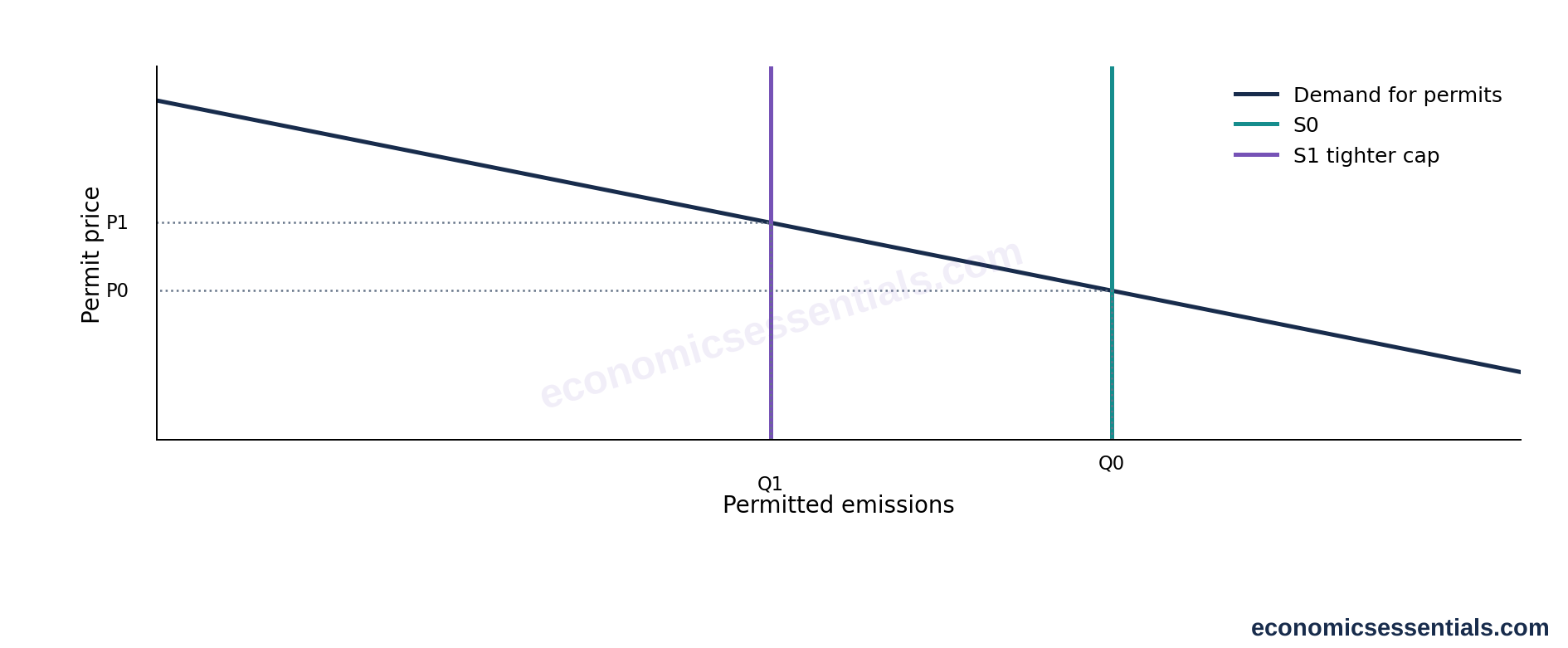
A fixed cap creates vertical permit supply. A tighter cap from S0 to S1 raises the permit price with demand unchanged. A tax instead fixes a price incentive and leaves the emissions quantity to respond. The cap must be monitored and enforced.
Regulation can ban a dangerous chemical, impose emission standards or require cleaner production. It can be effective when damage is severe or a clear minimum standard is necessary. However, a uniform standard may impose very different costs on firms and offer little incentive to improve beyond compliance. Information provision may change behaviour at relatively low cost but depends on trust, attention and available alternatives.
State provision can coordinate infrastructure, such as reliable public transport, that makes cleaner choices feasible. Subsidies for research may support technologies with knowledge spillovers. These instruments can complement emissions pricing rather than compete with it: a price signal works better when firms and households can actually substitute towards cleaner options.
Evaluation should consider coverage, enforcement and international leakage. Firms may shift output to places outside the scheme, reducing domestic emissions without equivalent global improvement. Monitoring small sources can be expensive. The strongest policy package balances environmental certainty, adjustment costs, distribution and innovation. A diagram of a fixed permit supply explains the price mechanism, but does not by itself prove that the cap matches the socially efficient level.
Key terms
- Tradable permit
- A transferable right to emit a specified amount of pollution.
- Emissions cap
- The maximum total emissions permitted under a policy.
- Regulation
- Rules that constrain or require particular behaviour.
- Marginal abatement cost
- The additional cost of reducing pollution by one more unit.
- Incentive
- A change in expected benefits or costs that influences a choice.