Free lesson · Edexcel Economics A · 3.4.4
Oligopoly, strategy and game theory
An oligopoly is dominated by a small number of significant firms. High entry barriers, product differentiation and concentration often give established producers market power. The defining strategic feature is interdependence: one firm’s best action depends on how rivals respond. A price cut may attract customers, but a matching cut by competitors can leave everyone with lower margins.
An n-firm concentration ratio adds the market shares of the largest n firms. If the four largest shares are 30%, 25%, 15% and 10%, the four-firm ratio is 80%. This indicates concentration, but market definition matters. A national ratio may conceal intense local concentration, while imports or digital substitutes may create competition beyond the measured industry.
Firms may collude to increase joint profit by restricting output or coordinating prices. Overt collusion involves explicit agreement, including cartels. Tacit collusion involves coordination without an explicit agreement, possibly through price leadership. Common costs or similar prices do not by themselves establish collusion. Agreements are vulnerable to cheating because each firm can gain by secretly expanding sales.
Worked example: two firms can charge a high or low price. If both charge high, each earns £50. If one cuts while the other stays high, the cutter earns £70 and its rival £10. If both cut, each earns £30. Cutting is individually preferable whatever the rival does, so both choose low even though joint profit would be higher with both high. This is the prisoner’s dilemma and a Nash equilibrium: neither improves by changing alone.
A two firm prisoner dilemma
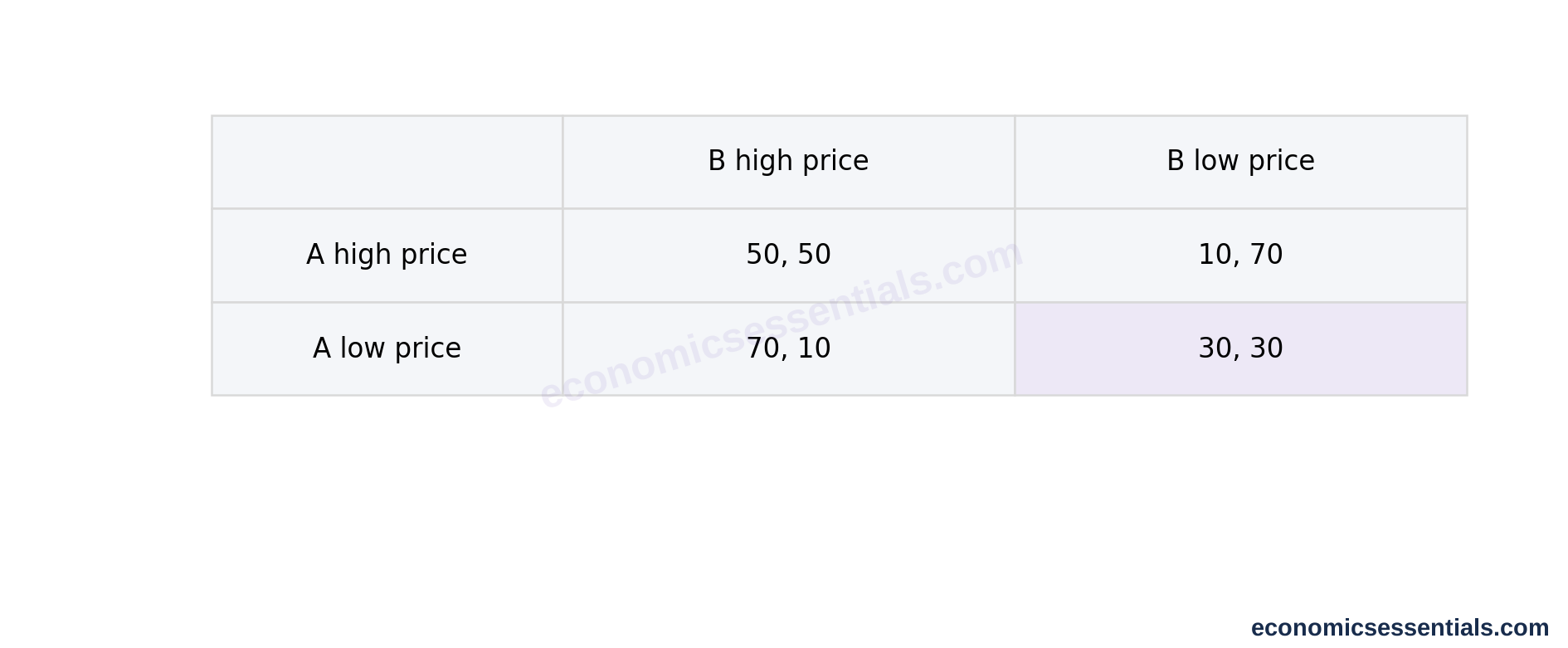
Payoffs are profits for A then B. Low price is the best response for either firm whichever action the rival takes. Both low is a Nash equilibrium, though both high gives greater joint profit. Repeated interaction may change incentives.
Repeated interaction can alter incentives. Firms may resist a short-run gain from cheating if they expect damaging retaliation. Coordination is easier with few firms, transparent prices, stable demand and barriers protecting the group. New entrants, unpredictable demand and different cost structures make collusion harder.
Price competition includes price wars, limit pricing and predatory pricing. Limit pricing sets a price intended to discourage entry by making the market appear less profitable. Predatory pricing involves sacrificing current returns, potentially pricing below a relevant cost measure, to exclude rivals and recover losses later. Not every low price is predatory; cost and strategic evidence matter.
Non-price competition includes product quality, branding, advertising, customer service, innovation and loyalty schemes. These can benefit consumers while also raising entry barriers. Firms may compete strongly in some dimensions while avoiding aggressive price cuts.
Evaluation should resist assuming that concentration guarantees poor outcomes. Large firms may exploit scale economies and fund research, while interdependence can generate fierce rivalry. Assess entry conditions, actual conduct, innovation and consumer outcomes. The payoff matrix explains incentives under stated assumptions; it is not evidence that real firms necessarily face those exact payoffs.
Key terms
- Oligopoly
- A market dominated by a few interdependent firms.
- Concentration ratio
- The combined market share of a specified number of the largest firms.
- Collusion
- Coordination between firms that reduces competition.
- Dominant strategy
- A strategy giving a player the best payoff regardless of rivals’ choices.
- Nash equilibrium
- A set of choices where no player benefits by changing alone, given others’ choices.