Free lesson · Edexcel Economics A · 2.6.1, 2.6.2
Fiscal policy and public budgets
Fiscal policy uses government spending and taxation to influence the economy. Expansionary policy raises spending or reduces taxes to support aggregate demand. Contractionary policy does the reverse. Governments pursue several objectives: growth, low unemployment, low and stable inflation, external balance, sound public finances, environmental protection and a fairer distribution of income.
A fiscal deficit occurs when expenditure exceeds revenue over a period; a surplus occurs when revenue exceeds expenditure. These flows differ from the accumulated stock of national debt. Direct taxes are levied on income or wealth, such as income tax. Indirect taxes are charged on spending, such as VAT. Cutting a direct tax can raise disposable income; cutting an indirect tax can reduce prices if businesses pass it on.
Government purchases raise AD directly, while tax changes operate through household and business behaviour. A tax cut may partly be saved or spent on imports. Public investment can also improve long-run supply, whereas some current spending mainly supports immediate services. The effect therefore depends on both the size and composition of a package.
Worked example: government purchases rise £2 billion and the relevant real-income multiplier is estimated at 1.5. The simplified predicted output increase is £3 billion. If a £2 billion tax cut causes households initially to spend only 75% of the extra income domestically, the initial demand impulse is £1.5 billion, before subsequent rounds. Equal budget costs need not create equal demand effects.
Demand management and equilibrium
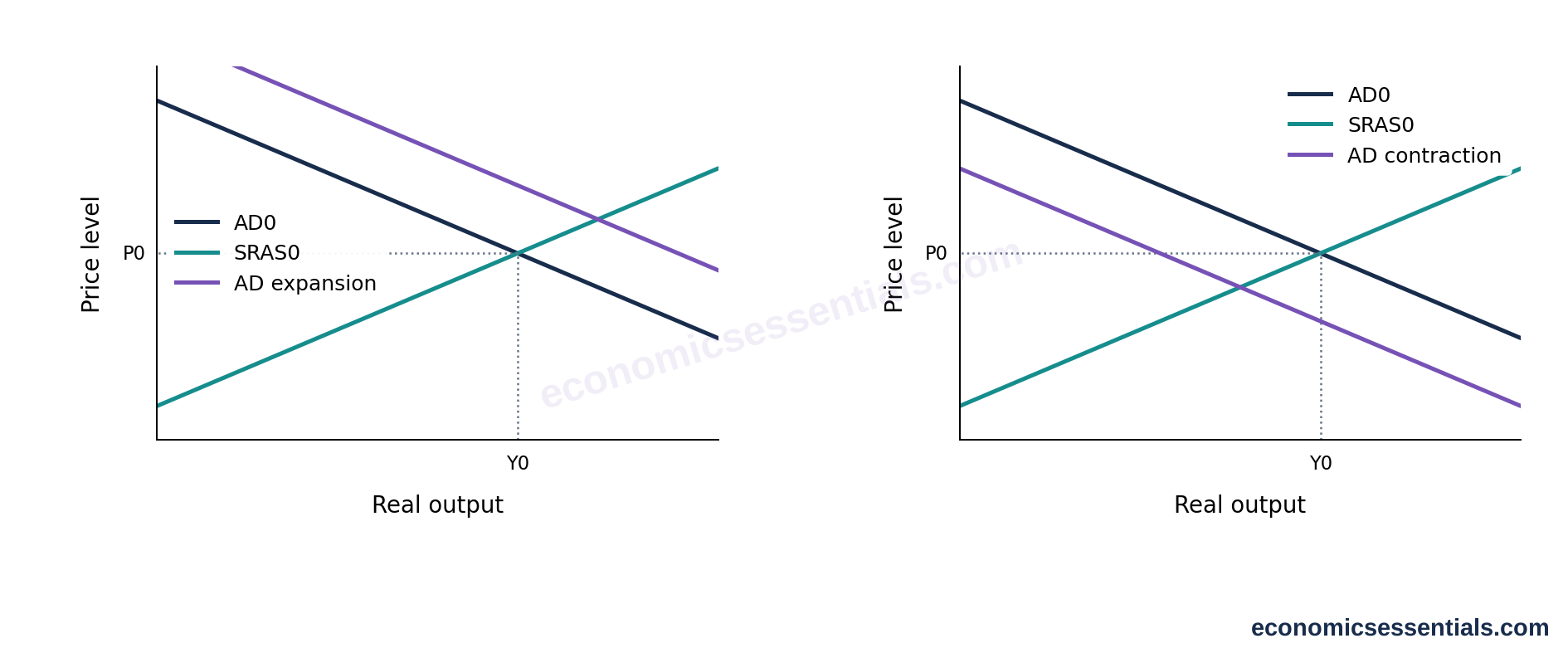
Expansionary fiscal or monetary policy can shift AD right; contractionary policy can shift it left. These diagrams hold SRAS constant. The real-output effect depends on spare capacity and the shape of aggregate supply.
Fiscal policy is especially useful when demand is weak and monetary policy has limited room to stimulate borrowing. Public works and transfers can support incomes directly. However, legislation, procurement and construction create time lags. Poorly selected projects waste resources, and government borrowing may raise financing costs or displace private investment when resources are already heavily employed.
Historical interpretation matters. During the Great Depression, Keynesian analysis emphasised deficient demand and the case for public spending, while monetary explanations stressed banking failures and monetary contraction. The UK left the gold standard in 1931 and benefited from cheaper money; US New Deal measures expanded intervention, but recovery cannot be attributed to one policy alone. After the 2008 financial crisis, UK and US authorities used fiscal support alongside bank rescue and monetary easing, followed by differing paths of fiscal consolidation.
Evaluation asks whether the economy has spare capacity, whether borrowing is sustainable and how the central bank responds. A temporary targeted measure may stabilise a recession with less long-term cost than a permanent commitment. Conversely, cutting productive investment to reduce a deficit may weaken future growth. A reasoned conclusion weighs stabilisation, distribution and supply effects together rather than assuming every deficit is harmful or every spending increase effective.
Key terms
- Fiscal policy
- Government decisions about taxation and expenditure to influence economic activity.
- Automatic stabiliser
- A tax or spending response that moderates fluctuations without a new policy decision.
- Budget deficit
- Government expenditure exceeds government revenue over a period.
- Crowding out
- Public activity displaces private spending or resource use.
- Discretionary policy
- A deliberate change in policy rather than an automatic response.