Free lesson · Edexcel Economics A · 2.5.1, 2.5.2, 2.5.3, 2.5.4
Growth, output gaps and the business cycle
Actual growth is an increase in real output; potential growth is an increase in the economy’s productive capacity. Actual output can rise because unemployed resources are brought into use, without an immediate outward shift of productive potential. Sustainable long-run growth requires improvements in resources, productivity or both.
Investment, innovation, education, infrastructure and a larger effective workforce can expand capacity. Export-led growth begins with stronger overseas demand and can encourage investment and specialisation. However, dependence on external markets exposes firms to foreign recessions and protectionism. A demand-driven expansion can raise output quickly where spare capacity exists, but cannot indefinitely outpace capacity without inflationary pressure.
The output gap is the difference between actual and estimated potential output. A negative gap indicates spare capacity; a positive gap means output temporarily exceeds its sustainable level, for example through overtime and unusually intense use of equipment. Potential output is estimated rather than directly observed, so measurements are uncertain and often revised.
Worked example: potential output is estimated at £1,000 billion and actual output is £960 billion. The percentage output gap is (960 − 1,000) ÷ 1,000 × 100 = −4%. If actual output grows 3% but potential grows 1%, the gap narrows. A positive growth rate does not itself prove that a negative output gap has disappeared.
A negative output gap
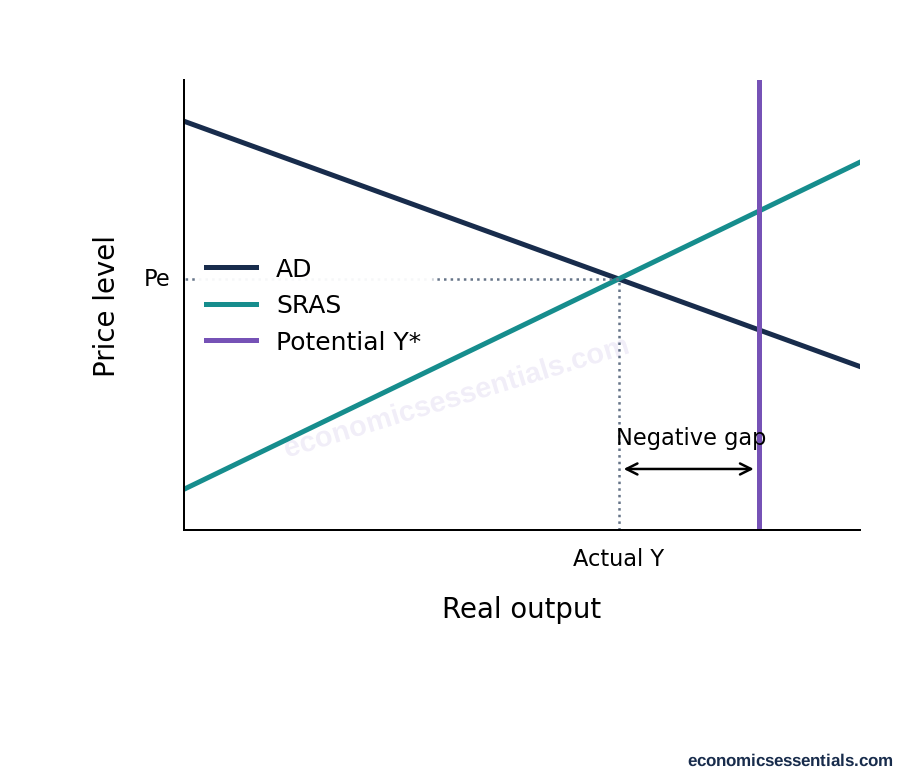
Actual output is below potential output. The distance between actual Y and potential Y shows spare capacity, although potential output must be estimated.
The business cycle describes fluctuations around the long-run trend. A boom typically involves strong demand, rising employment, high capacity utilisation and possible inflation or import pressure. A downturn involves weaker spending, investment and confidence. Two consecutive quarters of falling real GDP is a common technical recession rule, but broader assessments also consider employment, income and the depth and spread of weakness.
The business cycle and trend
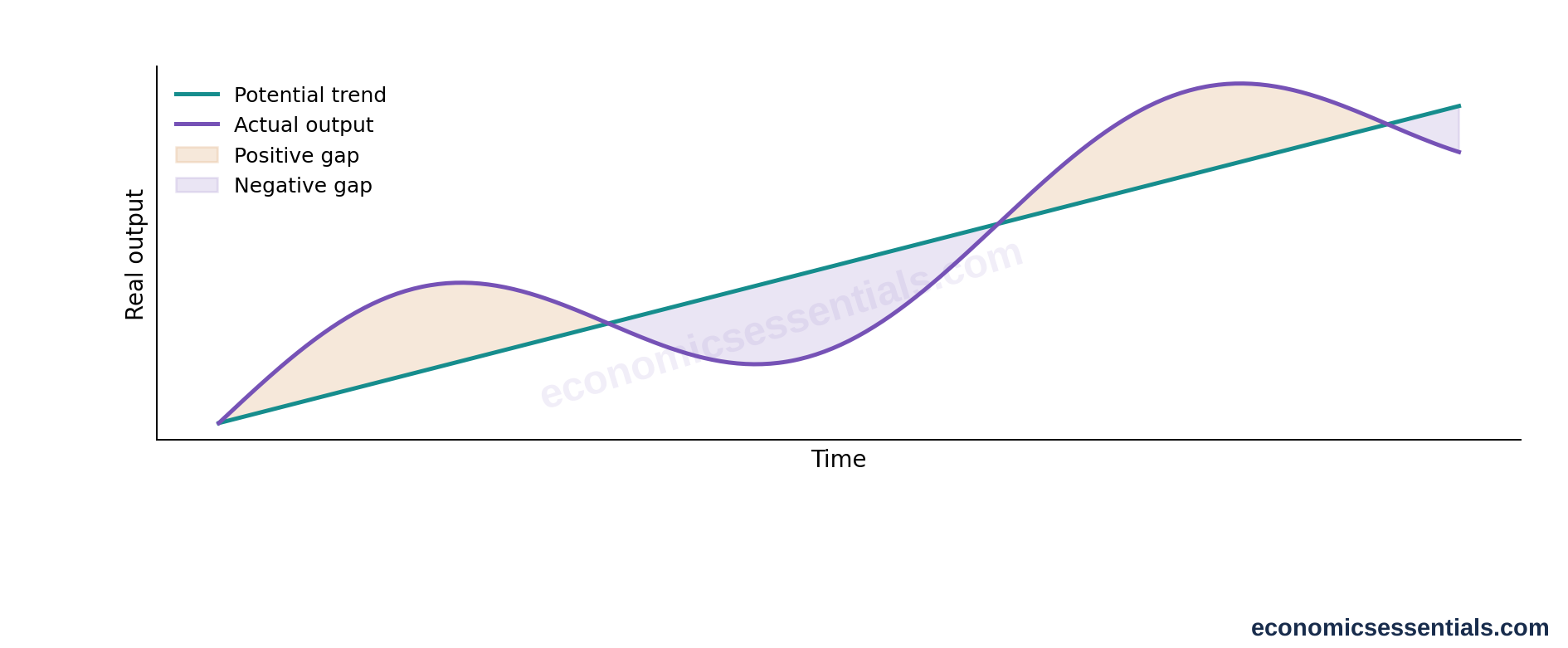
Actual output fluctuates around estimated potential output. A positive gap is output above the sustainable trend; a negative gap is below it. Potential output and gaps are estimates, and a rising level can still lie below trend.
Growth can raise real incomes, widen consumption choices, support business profits and generate tax revenue for public services. It can reduce some forms of poverty and improve health or education when resources are used effectively. However, benefits may be unevenly shared, working hours may increase, and pollution or resource depletion can damage present and future living standards.
Evaluation should examine the source and composition of growth. Productivity-led expansion can increase wages without equivalent inflation pressure. A debt-financed property boom may prove fragile. More GDP does not necessarily compensate communities harmed by environmental damage or displacement. Investment in cleaner technology can reduce some trade-offs, but it has an opportunity cost.
Distinguish short-run stabilisation from long-run development. Stimulating demand may close a negative gap, while skills and investment expand the frontier. The best judgement asks whether growth is sustainable, inclusive and supported by productive improvements, rather than treating the largest short-run growth rate as automatically the best outcome.
Key terms
- Actual growth
- An increase in real output produced.
- Potential growth
- An increase in an economy’s productive capacity.
- Output gap
- The difference between actual and potential output, usually expressed as a percentage of potential output.
- Negative output gap
- Actual output is below potential output.
- Business cycle
- Fluctuations in economic activity around the economy’s longer-term path.