Free lesson · Edexcel Economics A · 4.1.7, 4.1.8
External balances and exchange-rate systems
The balance of payments links trade and income flows with cross-border financing. The current account records goods, services, primary income and secondary income. The capital account includes capital transfers and transactions in non-produced non-financial assets. The financial account records transactions in financial assets and liabilities, including direct investment, portfolio investment and reserve assets.
With consistent accounting, a current-account deficit is matched by corresponding financing and capital-account entries, allowing for errors and omissions. Avoid saying the balance of payments “does not balance.” Sign conventions differ between presentations, so explain whether a figure represents net lending, borrowing, an asset purchase or an inflow rather than relying on an unexplained plus sign.
A floating exchange rate is mainly determined by currency demand and supply. Demand for domestic currency can arise from exports and inward investment; supply can arise from imports and outward investment. Interest differentials, expected returns, inflation, confidence and speculation affect flows. Appreciation is a rise in a floating currency’s value; depreciation is a fall.
Worked example: sterling rises from $1.20 to $1.32 per pound, an appreciation of 10%. A UK product priced at £100 rises from $120 to $132 for a US buyer if its sterling price is unchanged. A $120 import falls from £100 to approximately £90.91. Reciprocal conversion means a 10% appreciation does not imply an exactly 10% fall in the domestic import price.
A fixed system maintains a target rate against another currency or basket. Revaluation and devaluation are official changes in that fixed parity. A managed system combines market movements with intervention. To support a currency, a central bank can buy it using foreign reserves or raise interest rates to encourage demand. To restrain appreciation, it can sell domestic currency and buy foreign assets.
Floating exchange rates and currency support
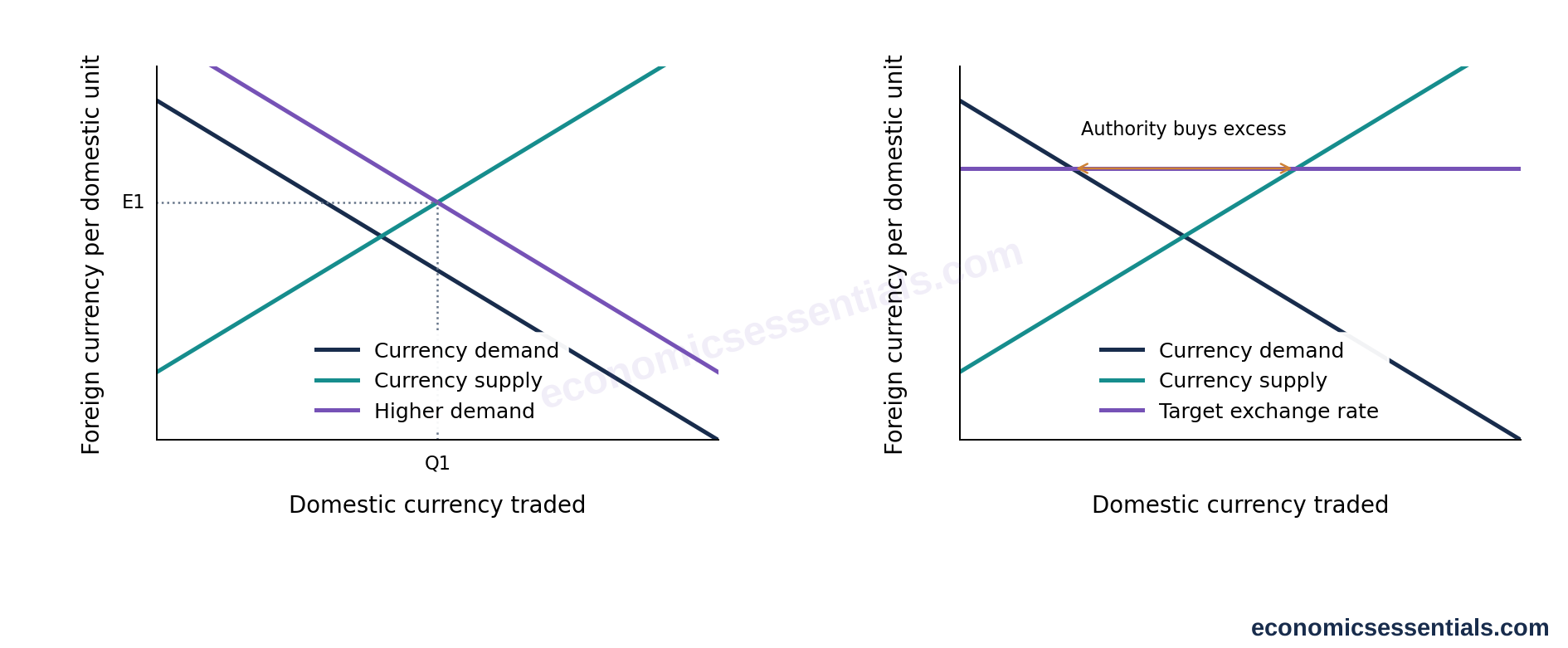
The vertical axis is foreign currency per unit of domestic currency: a rise is appreciation. Higher demand raises the exchange rate. Under a fixed target above the market rate, authorities must buy the excess supply of domestic currency, using reserves or changing incentives.
Fixed rates can reduce uncertainty and provide an inflation anchor, but defending an unsustainable rate may exhaust reserves or require damaging interest rates. Floating rates allow adjustment and monetary autonomy but can be volatile. Expectations can amplify pressure in either regime.
Persistent current-account deficits may reflect low saving, high investment or weak competitiveness. Policies include demand restraint, depreciation and supply improvements. Surpluses may reflect strong exports or weak domestic consumption. Global imbalances matter because deficit financing and surplus accumulation can create vulnerabilities and political tensions.
Evaluation examines the financing quality and adjustment cost. Long-term investment funding productive capacity differs from fragile short-term borrowing. No country controls foreign demand or investor sentiment completely. Exchange-rate policy should therefore be assessed alongside fiscal, monetary and supply-side measures, with attention to reserve adequacy, external debt and the credibility of the policy framework.
Key terms
- Floating exchange rate
- A currency price determined principally by foreign-exchange demand and supply.
- Fixed exchange rate
- A currency value maintained at a target through policy intervention.
- Managed exchange rate
- A system combining market movements with intervention to influence the exchange rate.
- Devaluation
- An official reduction in a currency’s value under a fixed or managed parity.
- Balance of payments
- A record of transactions between an economy’s residents and the rest of the world over a period.