Free lesson · Edexcel Economics A · 4.1.8
Depreciation, the J-curve and adjustment
A weaker currency can help exporters, but it does not guarantee an immediate improvement in the current account. Depreciation makes foreign currency more expensive in domestic terms. Export prices may fall for overseas customers and import prices may rise for domestic buyers, depending on invoicing and firms’ pricing decisions.
The Marshall–Lerner condition states that a depreciation improves the trade balance under the standard assumptions when the sum of the absolute price elasticities of export and import demand exceeds one. The familiar condition is commonly derived from an initially balanced trade position with sufficient supply responsiveness and price pass-through. Different initial positions and pricing behaviour require more careful analysis.
Worked example: export-demand elasticity is 0.7 and import-demand elasticity is 0.6. Their sum is 1.3, suggesting that a depreciation can improve the trade balance once quantities adjust under the model’s assumptions. If the sum is 0.6, quantity responses are too weak to offset the price effect in the standard balanced-trade case. The condition is not a formula for the exact size of the improvement.
The J curve describes a possible deterioration followed by improvement over time. Contracts and habits initially keep trade quantities relatively fixed, so a higher domestic-currency import bill can worsen the balance. Later, customers switch suppliers and firms expand exports or substitute domestic inputs. A graph plots the trade balance against time, with the early dip followed by recovery; this path is possible, not inevitable.
A possible J curve after depreciation
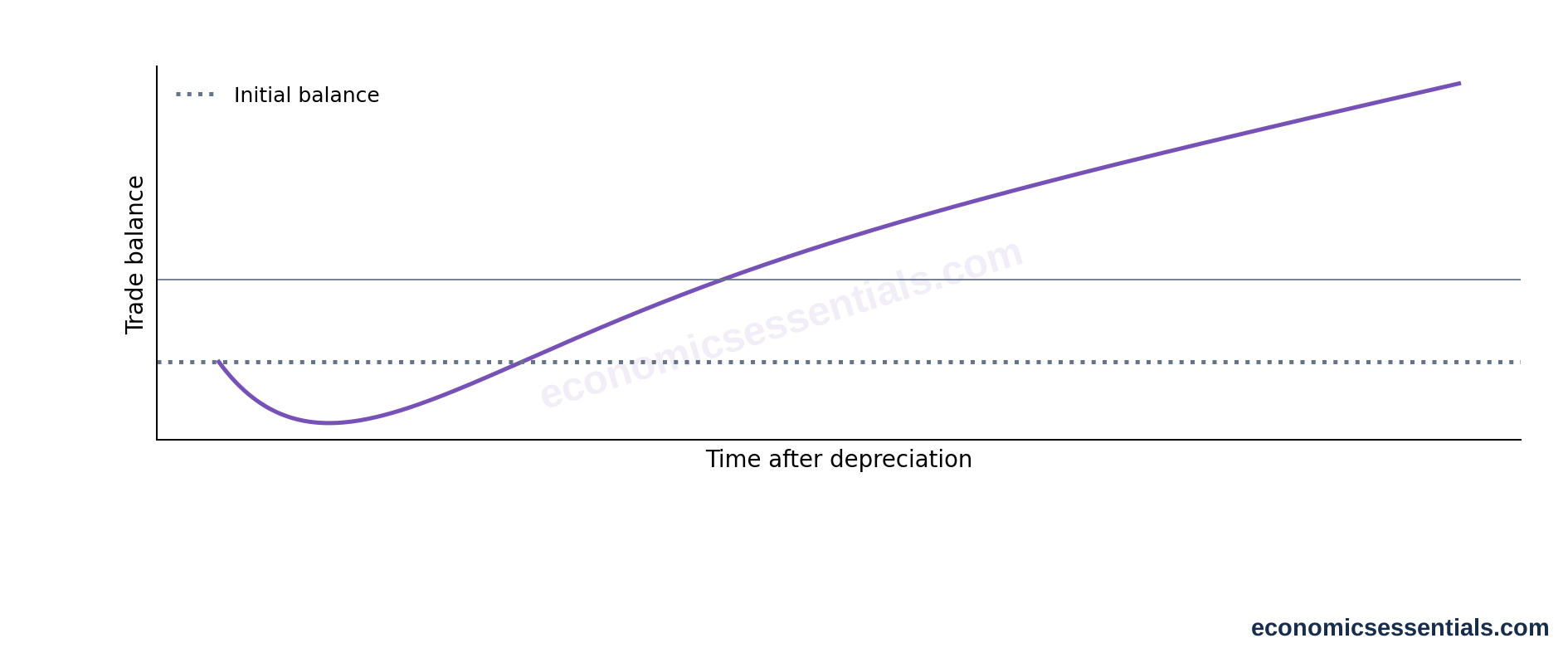
Existing contracts can make the import bill rise before quantities adjust. Later substitution and export expansion can improve the trade balance if demand elasticities and supply conditions permit. Recovery is conditional; depreciation need not produce this path.
Depreciation can raise net exports, AD, employment and growth where spare capacity exists. It can also increase import-price inflation and production costs, shifting SRAS left. Firms using many imported components may gain little competitiveness. Exporters at full capacity cannot rapidly expand output even if demand increases.
Foreign direct investment effects are mixed. Domestic assets become cheaper for foreign buyers, potentially attracting investment, and export production can become more attractive. However, instability, expected further depreciation and the higher cost of imported machinery can deter investors. Foreign-currency debt becomes more expensive to service in domestic currency.
Competitive devaluation or attempts to engineer depreciation can provoke retaliation. If many countries seek export advantage simultaneously, their gains offset and uncertainty or protectionism may rise. Exchange-rate changes cannot make every country’s net exports increase together.
Evaluation should specify the time horizon, elasticities, pass-through, supply capacity and trading partners’ response. Structural improvements in productivity and quality can complement depreciation and make an external adjustment more durable. A strong conclusion avoids treating a weaker exchange rate as a substitute for competitiveness: it may buy time, but sustained improvement depends on productive performance and credible macroeconomic management.
Key terms
- Depreciation
- A fall in a currency’s value under a floating exchange-rate system.
- Marshall–Lerner condition
- A depreciation improves the trade balance in the standard model if export and import demand elasticities sum to more than one in magnitude.
- J-curve
- A possible initial deterioration followed by improvement in the trade balance after depreciation.
- Expenditure switching
- A shift in spending between domestic and foreign goods.
- Time lag
- A delay between a change and its economic effects.