Free lesson · Edexcel Economics A · 4.1.6
Protectionism, tariffs and welfare
Protectionism restricts international trade to support domestic objectives. Arguments include protecting infant industries, preserving strategic capacity, responding to dumping, supporting employment and addressing environmental or labour-standard concerns. Each argument requires evidence: an industry’s desire to avoid competition is not itself proof that protection improves national welfare.
A tariff is a tax on imports. A quota limits import quantity. Subsidies lower domestic producers’ costs, while non-tariff barriers include product standards, administrative procedures and licensing requirements. Some standards correct genuine safety or information problems; others can be designed mainly to obstruct foreign competition.
In the small-country tariff model, the country takes the world price as given. A tariff raises the domestic price, increases domestic supply, reduces domestic demand and lowers imports. Producers gain surplus and government receives revenue, but consumers lose more than those gains combined. Two welfare-loss triangles represent inefficient extra domestic production and consumption no longer undertaken.
Worked example: world price is £10 and a £2 tariff raises the domestic price to £12. Domestic supply rises from 20 to 30 units and demand falls from 80 to 70. Imports fall from 60 to 40. Government revenue is £2 × 40 = £80. Production distortion is ½ × £2 × 10 = £10; consumption distortion is another £10. Net welfare loss is £20 under the model’s assumptions.
Small country tariff welfare
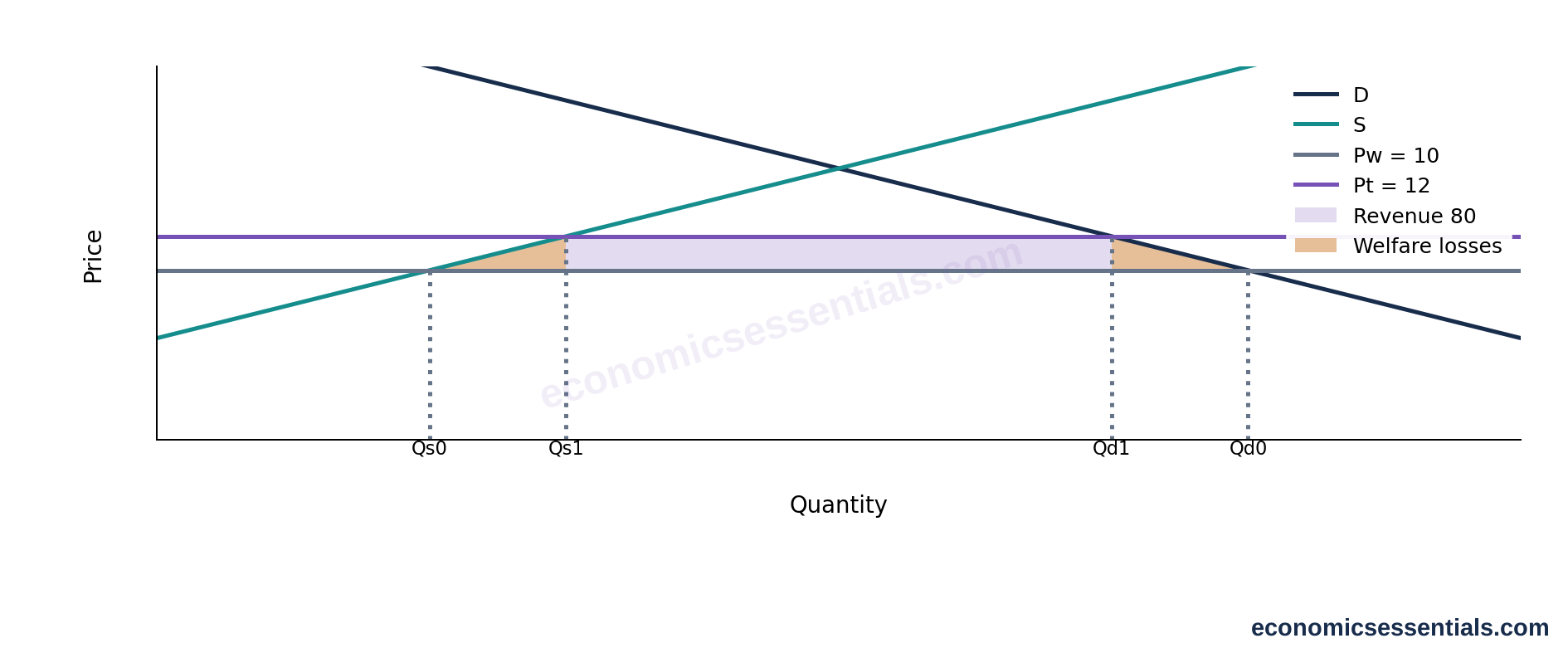
The tariff raises price from Pw to Pt. Domestic supply expands Qs0 to Qs1, demand contracts Qd0 to Qd1 and imports shrink. The central rectangle is revenue; the two shaded triangles are production and consumption distortions.
A quota producing the same import reduction can create similar price effects, but the scarcity rents may go to licence holders or foreign exporters rather than the domestic government. Auctioning licences can recover some revenue. A domestic production subsidy can increase supply without directly raising the consumer price in the same way, but taxpayers finance it and production may still become inefficient.
Protection can preserve jobs in the supported industry while harming exporters, downstream users and consumers. Higher prices reduce real incomes, with disproportionate effects where low-income households spend heavily on protected essentials. Retaliation can reduce foreign demand and weaken wider employment. Firms shielded indefinitely from rivalry may lose incentives to innovate.
Evaluation asks whether benefits are temporary, measurable and likely to exceed costs. Infant-industry support is stronger when learning spillovers exist, finance is constrained and support has a credible end date. A large country may influence world prices, but retaliation and international obligations complicate any potential terms-of-trade gain.
Compare trade restrictions with more targeted alternatives. Worker retraining, research support or direct environmental regulation may address the underlying problem with fewer trade distortions. The final judgement should assess consumers, producers, government revenue, equality and long-run productivity, rather than equating fewer imports with a healthier economy.
Key terms
- Tariff
- A tax on imports.
- Quota
- A quantitative limit on imports or another activity.
- Protectionism
- Policies that shelter domestic producers from foreign competition.
- Infant-industry argument
- Temporary protection may allow a new industry to develop capabilities and economies of scale.
- Retaliation
- A trading partner responds to a restriction with restrictions of its own.