Free lesson · Edexcel Economics A · 3.2.1, 3.3.1
Business objectives and revenue
A firm can increase sales without increasing profit. Understanding its objective is therefore essential before predicting price and output. Profit is total revenue minus total economic cost, including the opportunity cost of owners’ resources. Standard theory assumes firms maximise profit, but managers may instead target revenue, sales volume or a satisfactory return.
Total revenue is price multiplied by quantity. Average revenue is total revenue divided by quantity and equals price when all units sell at the same price. Marginal revenue is the change in total revenue from one additional unit. With downward-sloping demand and a single price, MR lies below AR because selling another unit requires lowering the price on existing units as well.
Worked example: selling ten units at £12 generates £120. Selling eleven at £11 generates £121, so marginal revenue from the extra unit is £1, not £11. Average revenue falls from £12 to £11. If total cost rises from £80 to £84, profit falls from £40 to £37 despite higher sales and revenue. More output is therefore not automatically desirable to a profit maximiser.
Total and marginal revenue
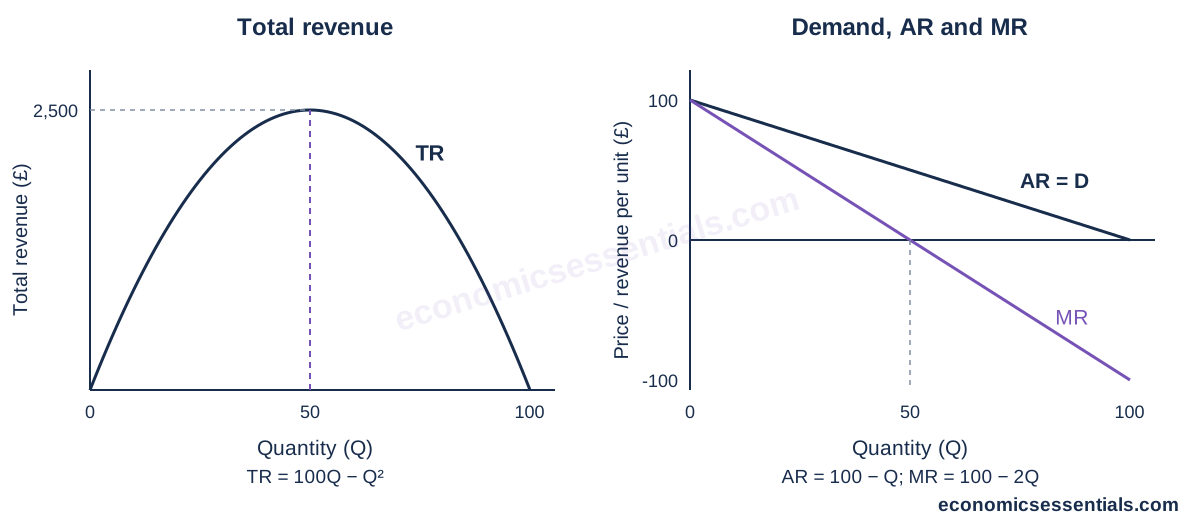
With demand P = 100 − Q, total revenue is 100Q − Q squared. It peaks at Q = 50 where MR is zero. Marginal revenue is positive on the elastic segment and negative on the inelastic segment.
Profit maximisation occurs where MC = MR, with MC crossing MR from below and the chosen point yielding the best feasible profit. If MR exceeds MC, an extra unit adds more revenue than cost; if MC exceeds MR, reducing output improves profit. Managers then read price from AR at the chosen quantity, rather than from the MR curve.
Revenue maximisation occurs where MR = 0, assuming the usual single-peaked total-revenue relationship. This corresponds to unit-elastic demand at a point. On the elastic part of demand, reducing price raises revenue; on the inelastic part, it reduces revenue. Sales-volume maximisation subject to avoiding economic losses occurs at the largest output where AR = AC. A specified minimum-profit constraint would change that boundary.
Output under alternative business objectives
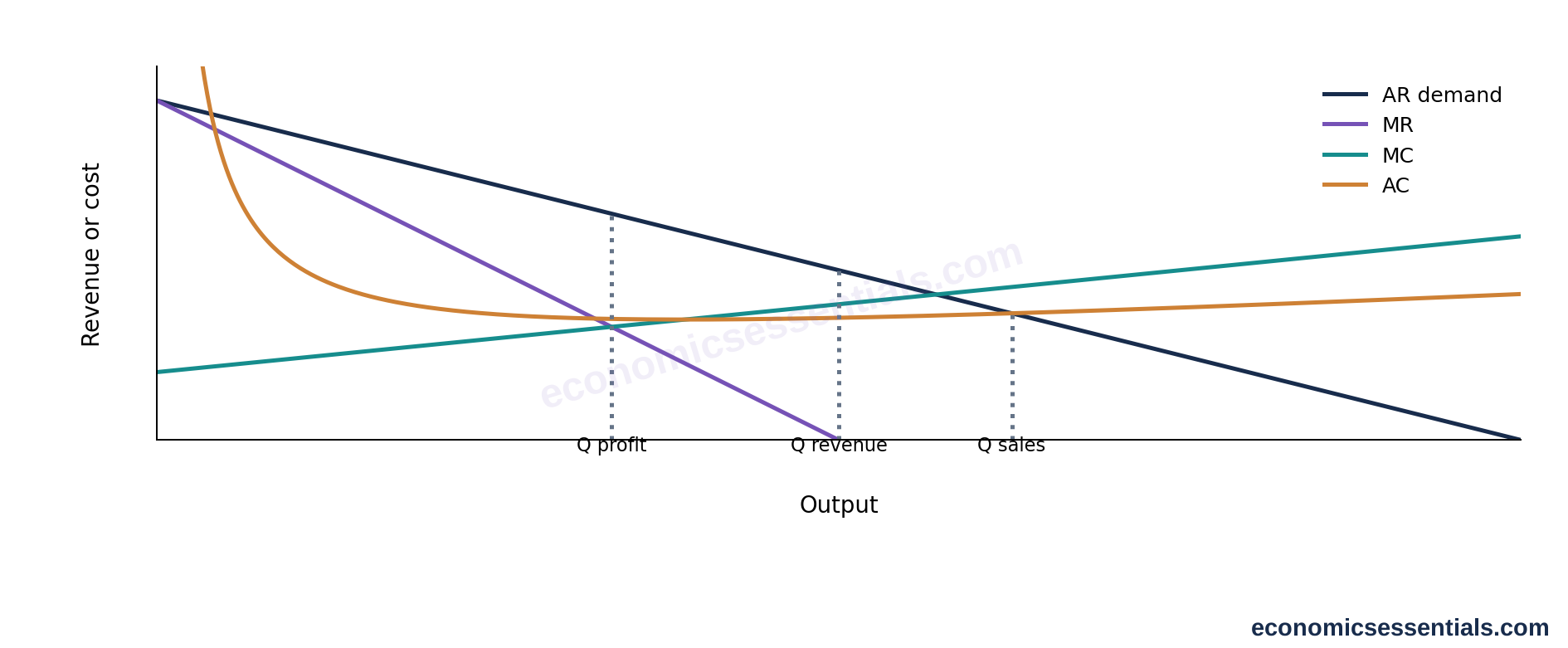
With these illustrative demand and cost curves, profit maximisation is at MR = MC, revenue maximisation at MR = 0 and sales-volume maximisation at the larger AR = AC intersection, subject to a no-loss constraint. Read each price from AR.
Satisficing means achieving an acceptable outcome rather than the theoretical maximum, perhaps because information and monitoring are costly. Managers may value market share, employment stability or reputation. Owner-managed firms may emphasise survival, while investor expectations or debt commitments can impose financial discipline.
The objective diagram compares these outputs under stated cost and demand conditions; their exact ordering is not universal without those conditions. A firm pursuing growth today may still maximise long-run profit if it expects later benefits. Introductory prices and research expenditure should not automatically be labelled irrational or non-profit behaviour.
Evaluation examines ownership, competition and time. Intense rivalry can limit managerial freedom, while weak monitoring may permit other objectives. Ask what evidence would distinguish revenue maximisation from a long-run profit strategy. Explain the relevant marginal condition, calculate the outcome and assess whether the assumed objective fits the organisation and its constraints.
Key terms
- Total revenue
- Price multiplied by quantity sold.
- Average revenue
- Total revenue divided by output; equal to price for a single-price seller.
- Marginal revenue
- The change in total revenue from selling one more unit.
- Profit maximisation
- Choosing output to maximise the difference between total revenue and total cost.
- Satisficing
- Pursuing an acceptable outcome rather than the greatest achievable outcome.