Free lesson · Edexcel Economics A · 1.2.2, 1.2.4, 1.2.6, 1.2.7
Demand, supply and the price mechanism
When strawberries become cheaper, shoppers usually buy more. Demand is the quantity consumers are willing and able to purchase at different prices over a specified period. A change in the product’s own price causes a movement along its demand curve. A change in income, tastes, population, expectations, advertising or related prices shifts the curve.
Supply is the quantity producers are willing and able to offer at different prices. A higher price usually encourages greater output because more production becomes worthwhile. Own-price changes cause movements along supply; changes in input costs, technology, taxes, subsidies, weather or the number of firms shift supply. Do not describe a higher market price itself as a rightward shift of supply.
Equilibrium occurs where quantity demanded equals quantity supplied. Above equilibrium, excess supply gives firms an incentive to reduce prices. Below equilibrium, excess demand encourages higher prices. These adjustments assume prices can change and buyers and sellers can respond. Contracts, regulation, queues and imperfect information can slow the process.
Worked example: suppose demand is Qd = 100 − 10P and supply is Qs = 20 + 10P. Equating them gives 100 − 10P = 20 + 10P, so P = £4 and Q = 60 units. At £3, demand is 70 and supply is 50: the shortage is 20 units. At £5, supply is 70 and demand is 50: the surplus is 20 units.
Excess demand and excess supply
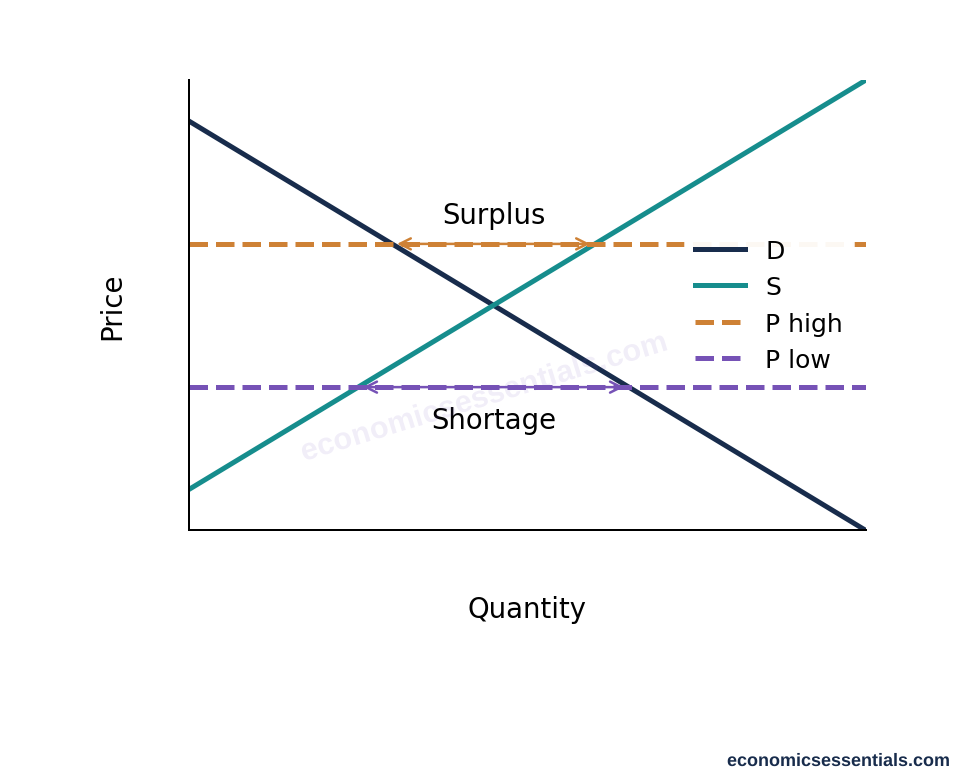
At the higher price, supply exceeds demand; unsold stock encourages price reductions. At the lower price, demand exceeds supply and puts upward pressure on price.
Now imagine a rise in the popularity of strawberries. Demand shifts right, increasing equilibrium price and quantity if supply is unchanged. Better harvesting technology shifts supply right, reducing price and increasing quantity if demand is unchanged. If both demand and supply rise, quantity increases but the price effect depends on the relative shifts. If demand rises while supply falls, price rises but quantity is ambiguous.
Shifts in demand and supply
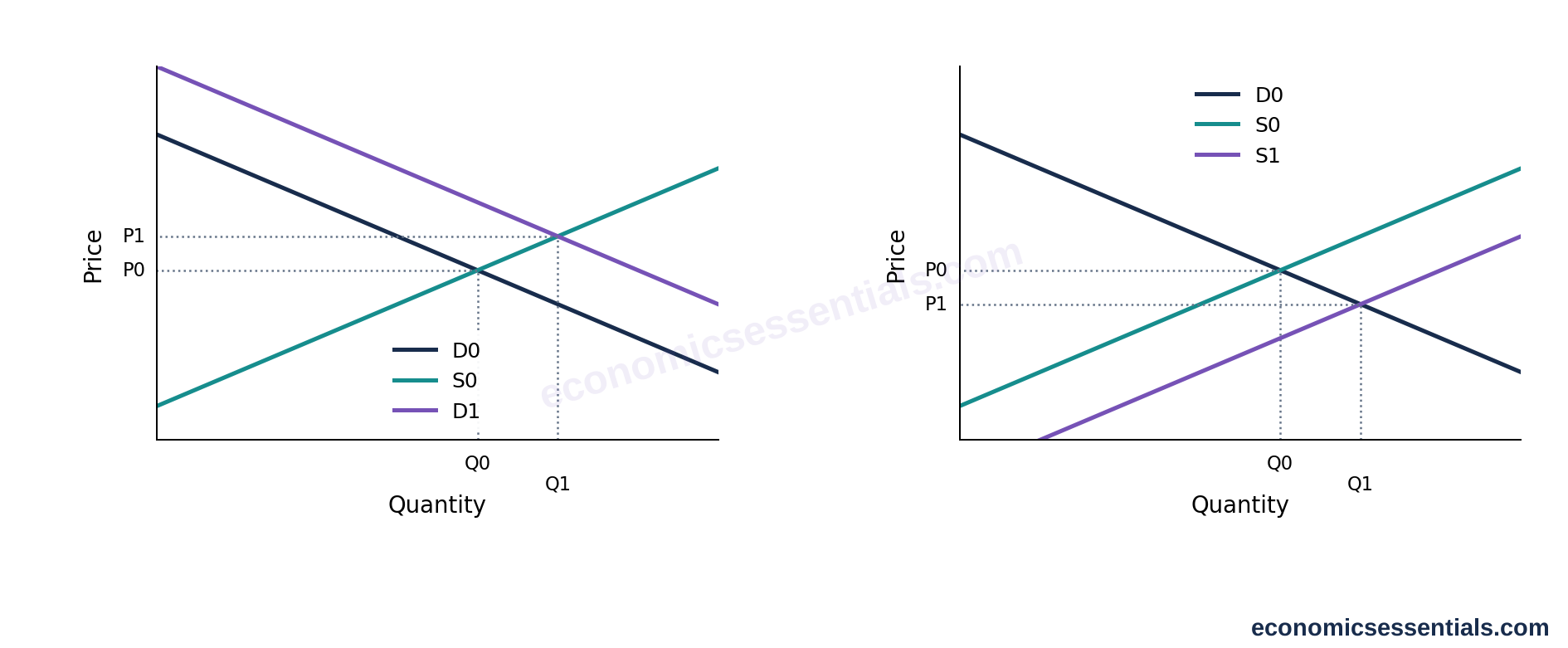
E0 to E1 shows the new equilibrium after one curve shifts. Demand growth raises price and quantity. Supply growth lowers price and raises quantity. The movement along the unchanged curve is a response to the shift.
Prices perform three connected functions. They signal relative scarcity, create incentives to alter production or consumption, and ration limited supplies among people willing and able to pay. A global coffee shortage can raise world prices, encourage new planting and discourage some consumption. The same mechanism operates in a local café or a national housing market, although adjustment times differ.
Evaluation requires attention to purchasing power. A market can clear while leaving low-income households unable to afford essentials. The price mechanism also overlooks unpriced pollution and may respond slowly when new supply takes years. A good market explanation therefore identifies the initial shift, traces the resulting shortage or surplus, and explains the movement towards a new equilibrium before assessing wider welfare effects.
Key terms
- Demand
- The quantity consumers are willing and able to buy at different prices over a period.
- Supply
- The quantity producers are willing and able to sell at different prices over a period.
- Equilibrium
- A position where quantity demanded equals quantity supplied.
- Excess demand
- Quantity demanded exceeds quantity supplied at the prevailing price.
- Excess supply
- Quantity supplied exceeds quantity demanded at the prevailing price.