Free lesson · Edexcel Economics A · 4.5.2
Tax design, incentives and the Laffer curve
Taxes finance public services and change the rewards from work, saving, investment and consumption. Their effects depend on the tax base, marginal rates, exemptions, enforcement and how revenue is used. A tax cannot be evaluated fully by looking only at the person legally responsible for paying it, because market adjustments can shift its economic burden.
A progressive tax has an average rate that rises with income; a proportional tax has a constant average rate; a regressive tax takes a falling income share as income rises. Marginal rates apply to additional income, while average rates describe total tax divided by total income. A household can face a high marginal rate even when its average rate is much lower.
Worked example: assume the first £10,000 is untaxed, the next £20,000 is taxed at 20%, and income above £30,000 at 40%. A person earning £40,000 pays £4,000 plus £4,000, or £8,000. The average rate is 20% and the marginal rate on the next pound is 40%. This is an illustrative schedule, not the current UK tax system.
Higher marginal income taxes reduce the financial reward from an extra hour of work, creating a substitution effect towards leisure. However, lower disposable income can encourage additional work to maintain living standards, an income effect in the opposite direction. The overall labour-supply response is empirical. Childcare costs, benefits withdrawal and employment opportunities also shape incentives.
Corporate and investment taxes affect expected after-tax returns and can influence FDI location, though infrastructure, skills, market access and political stability also matter. Lower indirect taxes can reduce prices if passed through; higher indirect taxes can raise the price level initially, reduce real purchasing power and restrain consumption. Weaker demand can reduce output, employment and imports, while tax-financed productive spending may improve long-run supply.
The Laffer curve relates tax revenue to the tax rate. Revenue can initially rise with rates, then fall if the tax base contracts sufficiently through reduced activity, avoidance or evasion. Its shape and peak differ across taxes and institutions. The stylised zero-revenue endpoints are assumptions of a simple diagram, not universal facts about every possible tax.
The stylised Laffer curve
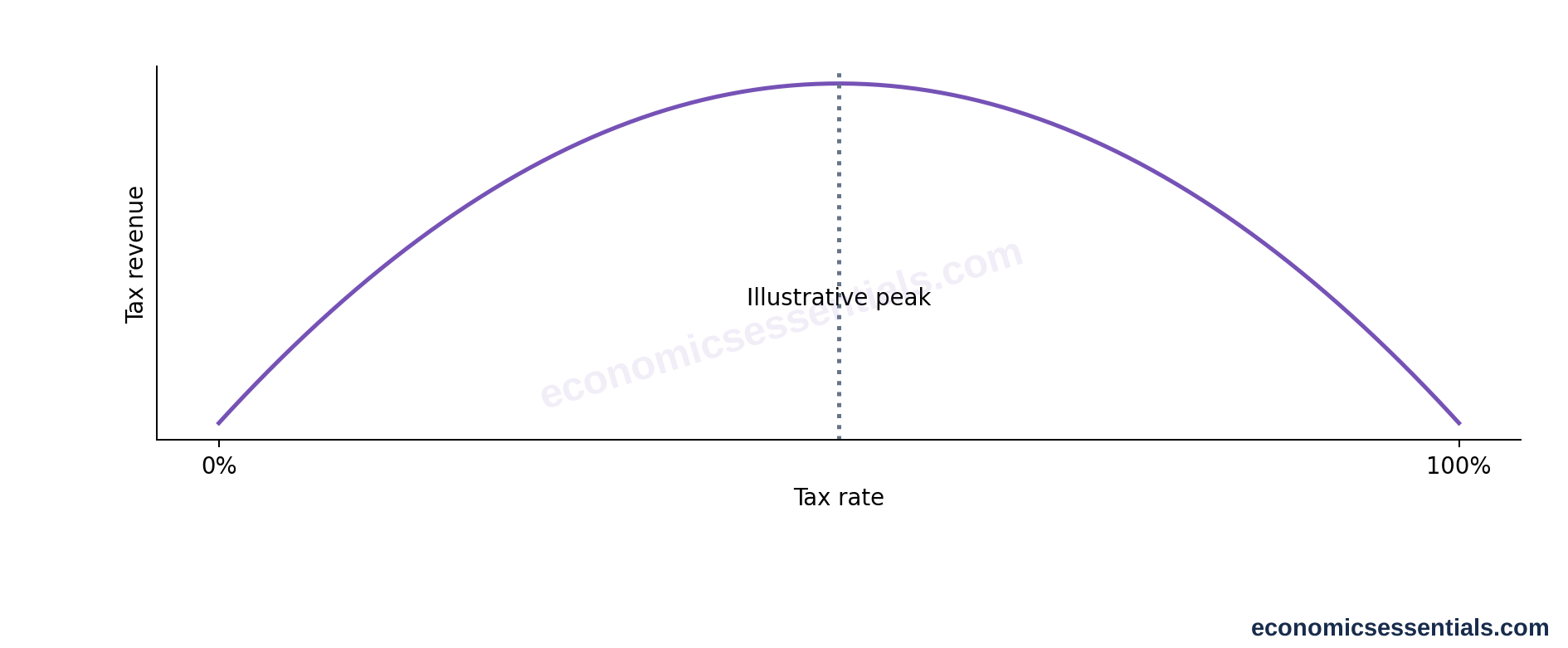
Revenue depends on the tax rate and the responsive tax base. The peak is deliberately unnumbered: its location requires evidence. The diagram alone does not show that a real tax cut would increase revenue, and the endpoints rely on simplified assumptions.
Evaluation must not infer that a tax cut pays for itself merely because a Laffer curve exists. That requires evidence that the initial rate lies beyond the revenue-maximising point and that the behavioural response is large enough. Distribution also matters: an efficient revenue system may still leave hardship unless transfers and services are considered. Judge tax changes jointly against revenue, incentives, equality, prices and the quality of spending they support.
Key terms
- Progressive tax
- A tax for which the average tax rate rises as the tax base increases.
- Proportional tax
- A tax with a constant average tax rate as the tax base increases.
- Regressive tax
- A tax for which the average tax rate falls as the tax base increases.
- Marginal tax rate
- The proportion of an additional unit of income paid in tax.
- Laffer curve
- A proposed relationship between a tax rate and the revenue it raises.