Free lesson · Edexcel Economics A · 1.1.4, 1.1.6
Production possibilities and economic systems
Imagine an economy choosing between consumer goods, which satisfy wants now, and capital goods, which help produce future output. A production possibility frontier, or PPF, shows the maximum feasible combinations of two outputs with available resources and technology. It describes a productive boundary, rather than the combination society necessarily prefers.
A point on the frontier is productively efficient: more of one good requires sacrificing some of the other. A point inside indicates unemployed or inefficiently used resources. A point outside is currently unattainable. Moving along the PPF changes the output mix. Moving from inside towards the frontier increases actual output without necessarily expanding productive potential.
A bowed-out frontier represents increasing opportunity cost. Resources suit some uses better than others, so transferring increasingly unsuitable resources makes each extra unit more costly. A straight frontier represents constant opportunity cost. The absolute slope measures the marginal opportunity cost of the good on the horizontal axis, expressed in units of the vertical-axis good.
Worked example: increasing machinery output from 20 to 25 units reduces food output from 100 to 85 tonnes. Five extra machines cost 15 tonnes of food, so the average opportunity cost over that interval is three tonnes per machine. A later increase might sacrifice more food per machine. Better technology or additional skilled workers can shift the frontier outwards; destruction of productive assets can shift it inwards. Growth can favour one sector, producing a pivot rather than a parallel expansion.
Production possibilities
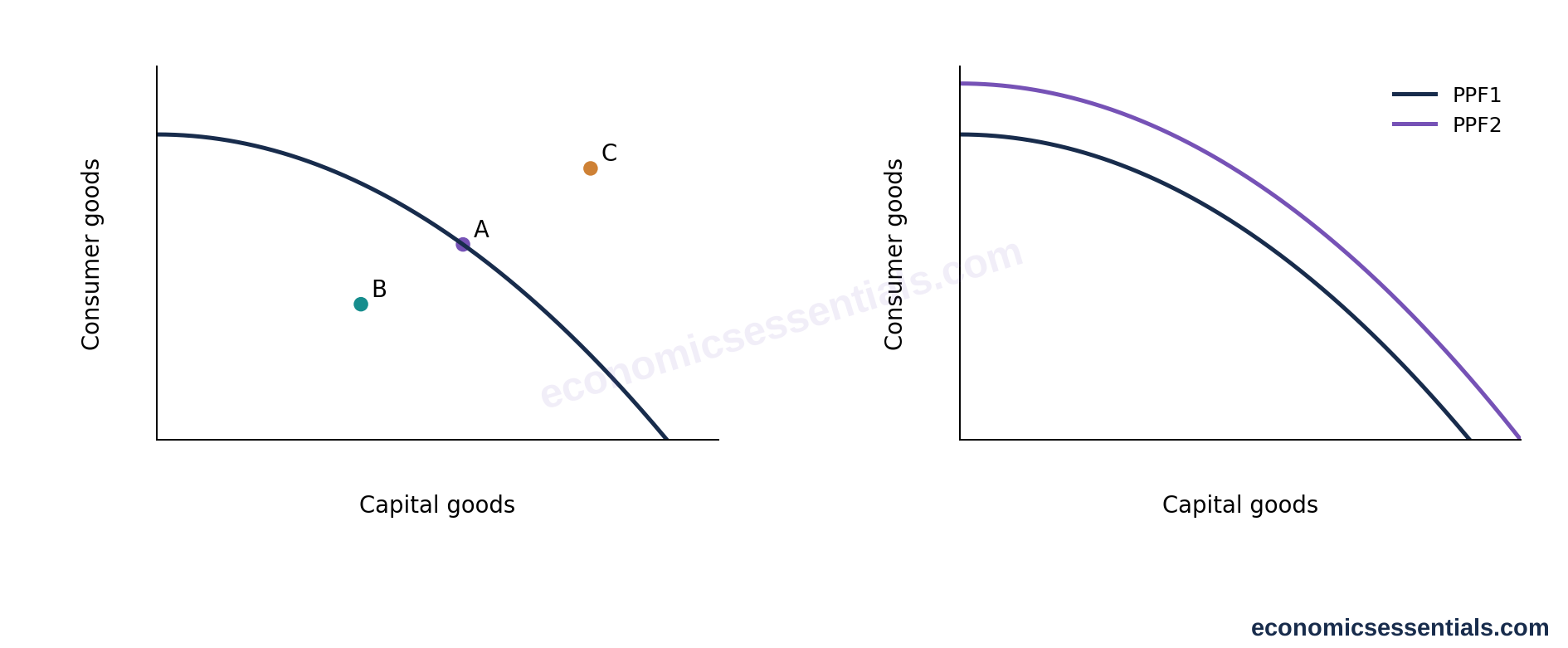
A is productively efficient, B is inefficient and C is currently unattainable. Movement along PPF1 trades one output for another. An outward shift expands productive potential; it does not guarantee the new capacity is used.
Who chooses the output mix? A free market relies mainly on private ownership and prices. Adam Smith explained how self-interest and competition can coordinate production. Friedrich Hayek emphasised the information communicated by decentralised prices: no planner possesses every local detail about scarcity and preferences. Competition can encourage innovation, but market outcomes reflect purchasing power and can ignore external costs.
A command economy uses central decisions over production and allocation. Planning can direct resources towards public priorities and reduce some inequalities, but information problems and weak incentives can generate shortages, surpluses and inefficiency. Karl Marx criticised capitalist ownership and exploitation; his analysis should not be reduced to a claim that every state intervention is Marxist.
Most economies are mixed. Markets coexist with taxation, regulation, public services and redistribution. Choosing more capital goods today may increase future capacity, but imposes a current consumption cost. Productive efficiency alone cannot identify the fairest or most desirable allocation. Evaluate economic systems against specific outcomes, including responsiveness, equality, sustainability and freedom of choice. The strongest judgement recognises that the effectiveness of either markets or planning depends on institutions and incentives.
Key terms
- Production possibility frontier
- The maximum combinations of two outputs possible with available resources and technology.
- Productive efficiency
- Producing output using the least resources for the given technology.
- Capital good
- A produced resource used to make other goods and services.
- Command economy
- An economy where the state makes the principal resource-allocation decisions.
- Mixed economy
- An economy combining market allocation with state intervention.