Free lesson · Edexcel Economics A · 2.1.2
Inflation, deflation and price indices
Inflation is a sustained increase in the general price level, not simply a rise in one product’s price. Disinflation means inflation is slowing while prices still rise. Deflation means the general price level is falling. If inflation drops from 8% to 3%, the price level continues increasing, just more slowly.
The Consumer Prices Index, or CPI, tracks prices across a representative basket of household goods and services. Categories receive expenditure weights reflecting their relative importance. Price changes are combined into an index, and annual inflation compares the index with the same period a year earlier. The basket and weights are updated to reflect changing spending patterns.
Worked example: suppose food has a weight of 40% and its price index is 110, while other spending has a weight of 60% and its index is 105. The combined index is 0.4 × 110 + 0.6 × 105 = 107. If the comparable previous index was 100, inflation is 7%. If next year’s index is 110.21, inflation is 3%, even though prices are now 10.21% above the original base.
CPI describes an average experience. Households spend different proportions on rent, food, transport and energy, so their personal inflation rates differ. Quality adjustment and new products are difficult to handle perfectly. CPI excludes owner-occupiers’ housing costs; CPIH includes a measure of these costs. RPI is an alternative index with different coverage, including mortgage interest payments, and different calculation methods. RPI has recognised methodological weaknesses, so the indices should not be treated as interchangeable.
Demand-pull inflation occurs when aggregate demand rises faster than productive capacity. Cost-push inflation follows higher production costs, such as energy or imported materials, shifting short-run aggregate supply left. Sustained money growth can support inflation when nominal spending grows faster than real output, but the relationship depends on money demand, bank lending and economic conditions.
Demand pull and cost push inflation
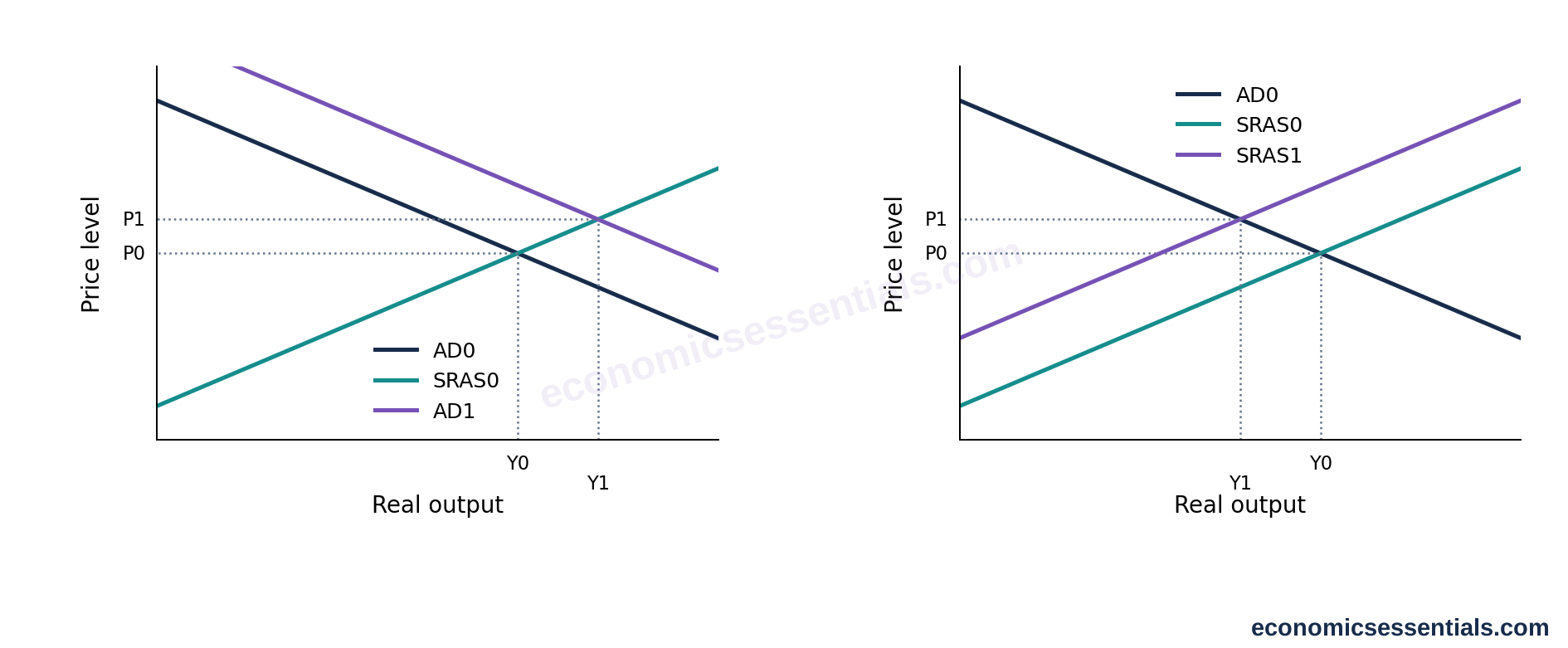
Left: stronger AD raises output and the price level. Right: higher production costs shift SRAS left, raising the price level while reducing output. These are alternative shocks, not simultaneous steps in one process.
Unexpected inflation redistributes purchasing power. Workers lose if wages lag behind prices; savers lose when returns fall below inflation; borrowers with fixed nominal debts may gain in real terms. Firms face uncertainty and adjustment costs, while governments may receive more nominal tax revenue but also face higher spending and borrowing costs. Effects depend on indexation and expectations.
Deflation can increase the real burden of debt and encourage postponement of purchases, weakening demand. However, falling prices caused by productivity growth need not have the same consequences as collapsing spending. Evaluation should identify the cause, duration and predictability of price changes. A temporary energy shock requires a different judgement from persistent demand pressure reinforced by wage and price expectations.
Key terms
- Inflation
- A sustained increase in the general price level.
- Deflation
- A sustained fall in the general price level.
- Disinflation
- A fall in the rate of inflation while prices may still be rising.
- Consumer Prices Index
- A weighted index tracking changes in prices of a representative basket of consumer purchases.
- Real income
- Income adjusted for changes in prices.