Free lesson · Edexcel Economics A · 4.3.3
Industrialisation and the Lewis model
Industrialisation can raise productivity by moving resources from low-productivity activities into manufacturing and modern services. The Lewis dual-sector model explains one possible development process through the transfer of labour from a traditional subsistence sector to a modern capitalist sector. It is a framework for structural change, not a promise that every economy follows the same path.
In the basic model, the traditional sector initially has surplus labour: some workers can leave with little or no reduction in its output. Modern employers offer a wage above subsistence earnings to attract them. While surplus labour remains available, the modern sector can recruit additional workers at a relatively stable real wage.
Modern-sector profits are reinvested in capital, expanding labour demand. Employment and output grow, more workers transfer and the process repeats. At the Lewis turning point, surplus labour is exhausted. Further recruitment requires higher wages or productivity improvements in the traditional sector. Labour supply to modern firms is no longer effectively horizontal at the previous wage.
Worked example: suppose a modern firm earns £1 million of profit and reinvests £600,000 in equipment that supports 30 additional jobs. If these workers leave genuinely surplus agricultural work, industrial output can rise without an equivalent fall in farm output. However, if the workers were essential at harvest time, the assumed surplus is seasonal rather than permanent, and the net gain is smaller than the simple model predicts.
The diagram shows a relatively elastic modern-sector labour supply before the turning point and a rising section afterwards. Successive outward shifts of labour demand increase employment first, then put greater pressure on wages. The demand shifts depend on actual investment and profitability; labour does not move automatically just because a city exists.
Lewis structural transformation
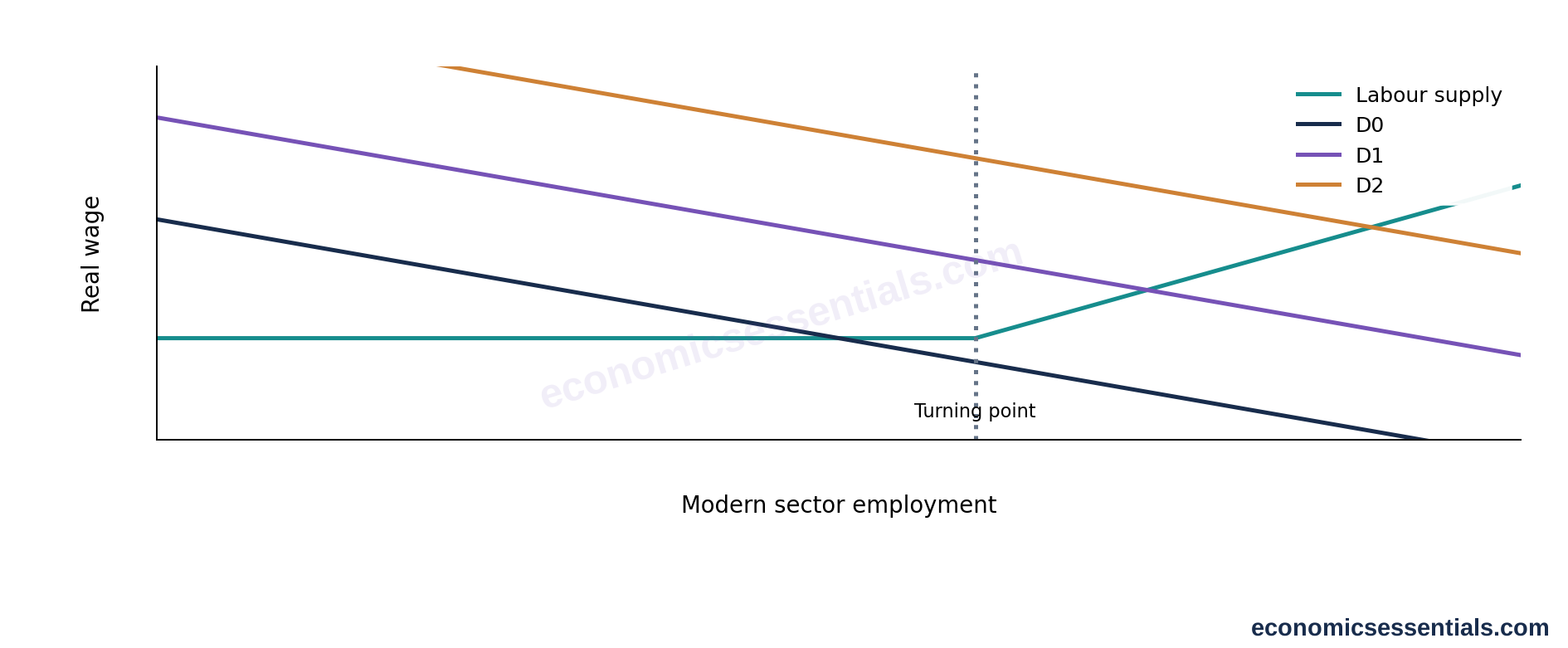
Before the turning point, modern firms can recruit surplus traditional-sector labour at the prevailing modern wage. Reinvestment shifts labour demand outward. After surplus labour is exhausted, further expansion puts upward pressure on wages.
The model highlights the importance of capital accumulation and productive job creation. However, profits may be spent on luxury imports, moved abroad or invested in labour-saving equipment rather than job-rich expansion. Urban housing, sanitation, transport and skills may constrain recruitment. Workers may enter informal urban unemployment rather than secure modern employment.
Agriculture can also have valuable productivity and export potential, so development should not be equated with abandoning rural activity. Better agricultural technology, market access and infrastructure can raise incomes and release labour more sustainably. Modern services may provide another route where manufacturing opportunities are limited.
Evaluation therefore examines the assumptions: is labour genuinely surplus, are profits reinvested locally, do firms create accessible jobs and can infrastructure support migration? Complementary education, finance and property rights matter. The strongest strategy supports structural transformation while protecting food production and living conditions. Industrialisation is useful when it raises broad productivity and capabilities, rather than merely increasing the number of factories or the urban population.
Key terms
- Structural transformation
- Movement of resources between sectors as an economy develops.
- Surplus labour
- Labour that can leave a sector with little or no loss of that sector’s output in the model.
- Marginal product of labour
- The extra output produced by one additional unit of labour.
- Reinvestment
- Using retained earnings to finance further capital or activity.
- Lewis turning point
- The stage at which surplus labour is exhausted and further industrial hiring puts upward pressure on wages.