Free lesson · Edexcel Economics A · 4.1.2
Comparative advantage and the gains from trade
Countries do not need to be the world’s best producer to gain from trade. Absolute advantage means producing more output with the same resources, or using fewer resources per unit. Comparative advantage means producing at a lower opportunity cost. It is comparative advantage that explains the basic mutual-gains argument.
Worked example: with the same resources, country A can produce either 40 tonnes of wheat or 20 machines. Country B can produce either 30 tonnes of wheat or ten machines. A has absolute advantage in both goods. In A, one machine costs two tonnes of wheat; in B, it costs three. A has comparative advantage in machines. One tonne of wheat costs half a machine in A and one third in B, so B has comparative advantage in wheat.
A mutually beneficial trading ratio lies between the two opportunity costs. At one machine for 2.5 tonnes of wheat, A receives more wheat than the two tonnes it sacrifices to make a machine. B obtains a machine for less than the three tonnes it would sacrifice domestically. Both can consume beyond their own production frontiers through specialisation and exchange, although production itself remains constrained by resources.
On a straight-line PPF, the intercepts show maximum outputs and the slope shows constant opportunity cost. A trading line through a production point has a slope reflecting the international exchange ratio. Consumption points outside the domestic PPF can become feasible. With increasing opportunity costs, complete specialisation is not necessary for gains, because domestic marginal costs can change as output expands.
Comparative advantage and consumption possibilities
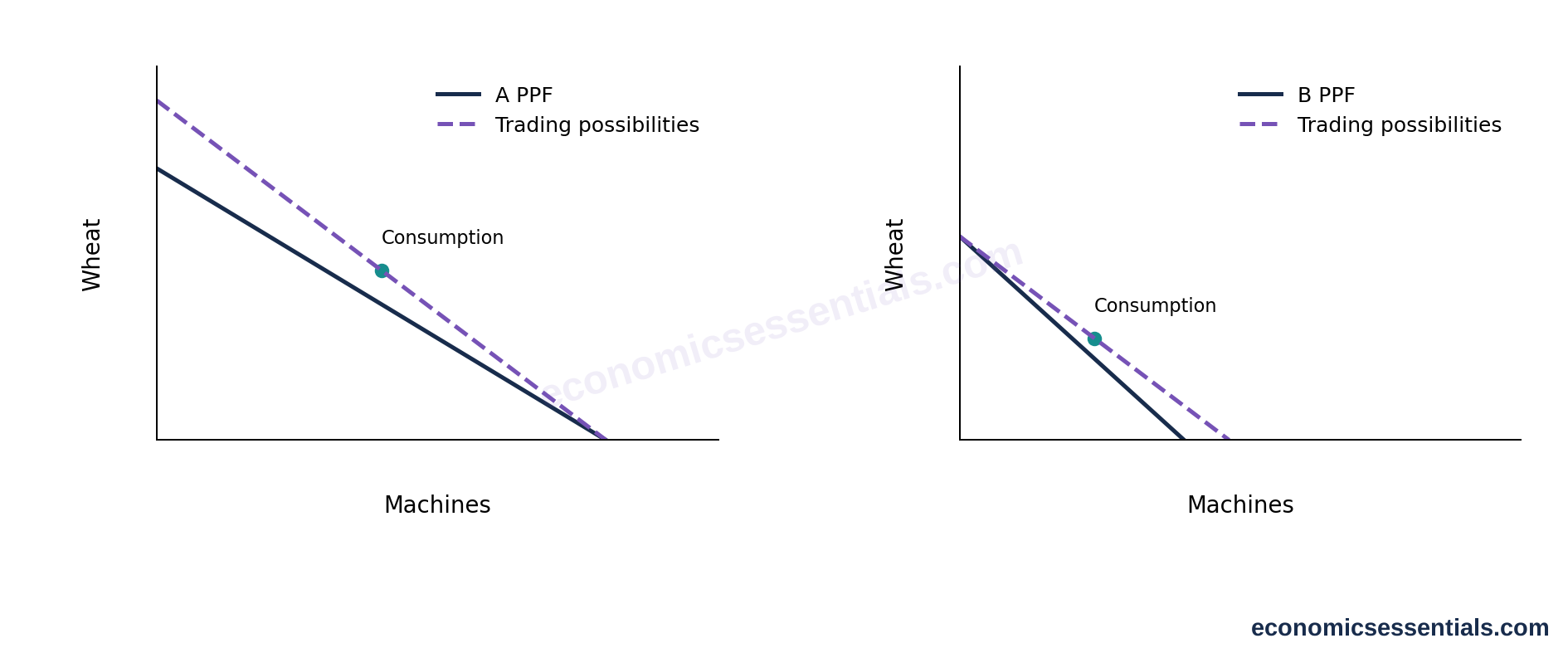
A can produce 40 wheat or 20 machines; B can produce 30 wheat or 10 machines. At one machine for 2.5 wheat, each can consume outside its domestic PPF through trade. The dashed trading line is not a new production frontier.
The model assumes resources can move between domestic industries, trade is possible and the relevant opportunity costs differ. Simple versions omit transport costs, barriers, unemployment, economies of scale and environmental effects. They also typically hold technology and resource supplies fixed. These assumptions explain why the model is a useful benchmark rather than a complete forecast.
Specialisation can increase output, consumer choice and scale economies. Competition can encourage productivity and innovation. However, dependence on a narrow export base increases vulnerability to price changes, demand shocks and supply disruption. Workers displaced from contracting industries may not move easily into expanding ones.
Evaluation should separate total gains from their distribution. A country may gain overall while some workers, firms or regions lose. The final trade ratio determines how gains are divided. Strategic capabilities and food or energy security may justify some diversification even when static opportunity costs favour concentration.
Use the numerical method carefully: compare opportunity costs within each country, not raw output differences between countries. Then identify a trading ratio between those costs and explain an actual gain for each participant. That demonstrates the mechanism more convincingly than saying simply that countries should specialise in what they produce best.
Key terms
- Absolute advantage
- Producing a good using fewer resources than another producer.
- Comparative advantage
- Producing a good at a lower opportunity cost than another producer.
- Opportunity cost
- The value of the next best alternative forgone.
- Specialisation
- Concentrating resources on particular activities or products.
- Gains from trade
- Benefits arising when exchange permits consumption beyond what isolated production allows.